
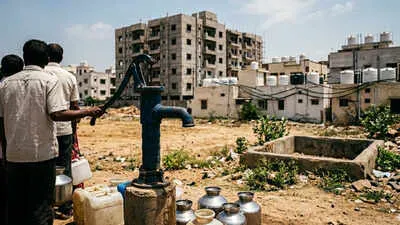
Groundwater levels in Hyderabad’s Core Urban Region (CURE), which covers GHMC, Cyberabad and Malkajgiri, have fallen sharply. The Ground Water Department (GWD) data for September 2026 shows the average depth at 11.58 metres below ground level (mbgl), against 4.73 mbgl in September 2025. That is a year-on-year drop of 6.85 metres. The assessment uses 107 piezometers across 46 mandals. Levels recovered only 0.42 metres from the May pre-monsoon low and dipped another 0.38 metres between August and September.
The decline is linked to a rainfall deficit under El Niño conditions. The Hyderabad region received 457 mm of rain up to 30 September, against a normal of 619 mm, a deficit of about 26%. Of the 46 monitored mandals, 33 were deficient, with shortfalls often between 21% and 49%. The state average depth was 7.52 mbgl, down 3.11 metres from 4.41 mbgl a year earlier. Hyderabad’s extraction was reported at about 102% of the available resource in the 2025–26 assessment period.
At least 14 mandals fall under extreme groundwater drought on the Groundwater Drought Index (GWDI). Bachupally has the worst GWDI in the state at -2.7, with levels near 30 mbgl, over three times the previous 10-year September maximum of 9.06 m. Ameerpet recorded the deepest level in the state at 32.07 mbgl, more than double the earlier maximum of 13.36 m. One piezometer near Greenlands reached about 34.99 mbgl. Other extreme-drought mandals include Saidabad (-1.15), Golconda (-1.02), Rajendranagar (-1.02), Hayathnagar (-0.91), Asifnagar, Secunderabad, Ghatkesar, Medipally, Kukatpally, Bandlaguda, Bahadurpura and Amberpet.
Several other areas show deep levels. Kukatpally averages about 20.67 mbgl, Hayathnagar about 19.46, Shankarpalle about 19.25 and Medipally about 18.23. Khairatabad, Balanagar, Quthbullapur, Gandipet and Abdullapurmet are in the severe drought category. Some pockets remain shallow, such as Shaikpet (1.87 m), Himayatnagar (2.90 m) and Miyapur (1.35 m). In Hyderabad district, about 7% of the area has levels beyond 20 mbgl. Many borewells that once worked at 300 feet are now dry even at 800–1,000 feet.
Demand for HMWSSB water tankers has surged out of season in October 2026. Daily bookings range from 5,000 to 8,000, against a normal off-season level of 800–1,500. October bookings reached about 1.5 lakh, compared with about 38,770 for all of October 2025. A mid-October snapshot showed 62,565 bookings, up 233% year-on-year. Boduppal saw the biggest spike, at over 2,000% in some data. LB Nagar, Manikonda, Durgam Cheruvu, Gachibowli, Madhapur, Kondapur and Serilingampally also reported high demand. The board plans to add 500 tankers to its fleet of about 1,200, including 50 focused on Boduppal. Domestic rates are ₹500 for 5 KL and ₹1,000 for 10 KL.
The city receives roughly 550–570 MGD. HMWSSB projects a 40–50 MGD daily shortfall for nearly eight months, as Singur and Manjira supplies, about 100 MGD or 20% of the total, decline sharply. An additional 60 MGD is planned from Godavari, Krishna and Osman Sagar, but a gap remains. Serilingampally faces up to 80% impact, and some localities receive supply once every 2–3 days. From 1 November, Green Water Tankers with treated wastewater will serve construction, gardening and other non-potable uses. The board is also targeting a 20% cut in consumption and has rejected viral claims that reservoirs will run dry by end-November. Chief Minister Revanth Reddy has warned that the El Niño-driven water and power crisis could last until July 2027. October groundwater figures are not yet released.
