
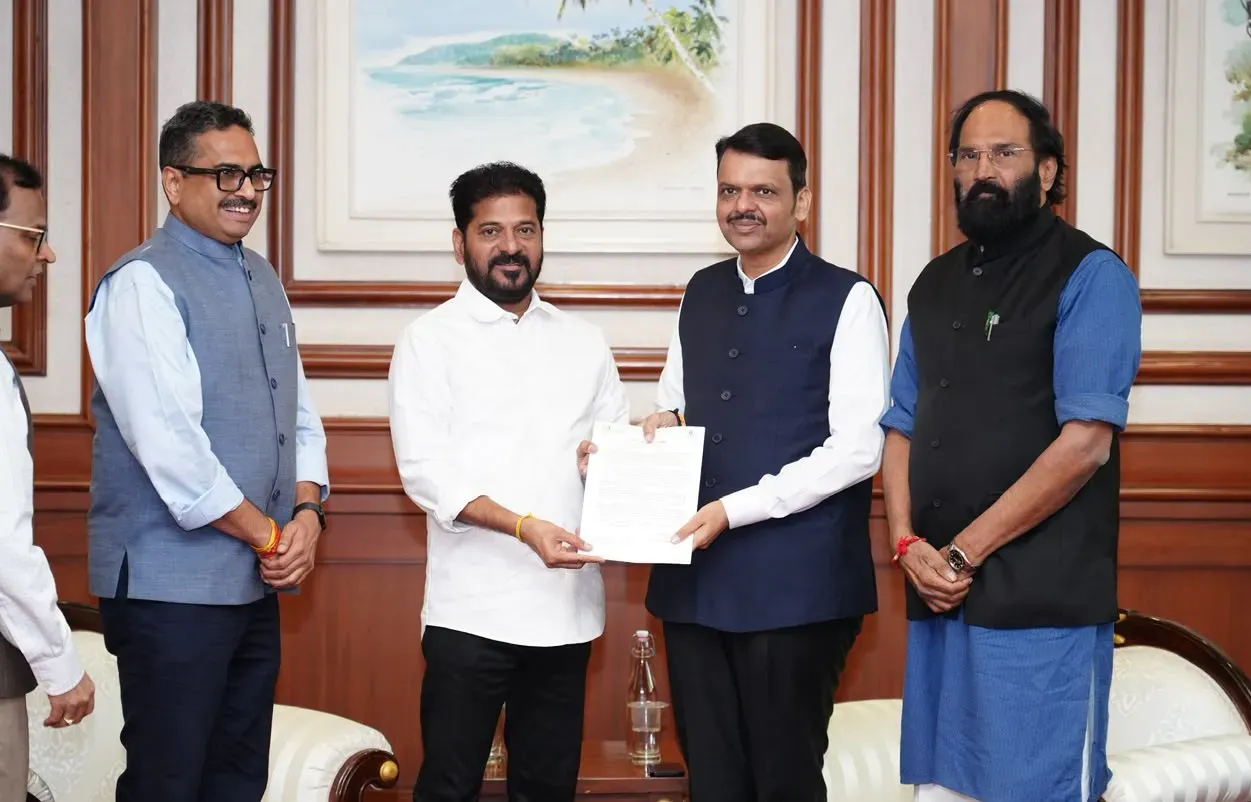
A key meeting on the Tummidihetti Barrage was held in Mumbai, where a Telangana delegation led by Chief Minister A. Revanth Reddy met Maharashtra Chief Minister Devendra Fadnavis. The meeting took place at the Sahyadri Government Guest House. Water Resources Minister N. Uttam Kumar Reddy, the chief secretaries of both states and senior Water Resources Department officials attended. The talks focused on building the barrage on the Pranahita River along the Telangana-Maharashtra border, including its height, water availability, flood impacts and other technical aspects.
At the start, Uttam Kumar Reddy gave a presentation on the priority of the project. He described the history, culture, living conditions of tribal communities and economic backwardness of the erstwhile Adilabad district. He said the district has lagged in development despite its rich heritage, and that development benefits have not reached tribals and indigenous people. He added that the lack of economic opportunities and backwardness had earlier led to problems such as Naxalism.
The minister traced efforts to supply irrigation water to the region from the agreement signed on October 6, 1975, between then Chief Minister Jalagam Vengal Rao and S.B. Chavan. He said many proposals and discussions have taken place over five decades, but the expected progress has not been achieved. He recalled that a 2016 agreement fixed the barrage height at 148 metres. He explained that this height would not fully meet the drinking water and irrigation needs of the Telangana region.
Uttam Kumar Reddy said power requirements, fuel costs, environmental protection, climate change and project operation costs must be considered. He stressed the need to prioritise water conveyance through gravity. In this context, he said a barrage height of 152 metres is the most beneficial option, and he explained its importance from technical, operational and financial angles. He also said the Telangana government is ready to pay compensation for farmland in Maharashtra affected by flooding, as per the land acquisition rules and compensation policy in force in Maharashtra.
Revanth Reddy recalled the historical and cultural ties between the two states, including the border areas’ link to the former Hyderabad State. He described Adilabad as a mainly backward forest region and referred to the Jal, Jungle, Zameen struggle led by Komaram Bheem. He said people there have awaited irrigation and drinking water for decades. He also pointed to the region’s strategic importance for national defence and to the proposed defence and civil airport in Adilabad, which he said would improve transport, economic activity and development in border areas of both states.
The Telangana Chief Minister said the Tummidihetti Barrage is not just an irrigation project and will also serve as a bridge physically connecting the two states. He appealed to Maharashtra to cooperate in its construction, keeping mutual benefits in mind. He said cooperation between the states is necessary for the development of backward regions and tribal welfare.
Fadnavis responded positively and recalled his close ties with Telangana, noting that his grandmother speaks Telugu. He said Maharashtra is ready to review the request to raise the barrage height, but technical, environmental and administrative aspects must be examined first. He said there is no objection to reviewing the 148-metre agreement if it does not adversely affect Maharashtra or its people. He added that the Central Water Commission (CWC) will carry out the necessary studies within its purview, and that Maharashtra has resolved several inter-state issues in the past through mutual discussions.
Fadnavis proposed a committee of officials led by the chief secretaries of the irrigation departments of both states. It would study barrage height, water availability, flood-affected lands in Maharashtra, compensation and other technical matters, and examine both states’ estimates of flood impact. It could also study alternatives if needed. Officials and technical experts of both states would consult each other, decide the schedule of further meetings and prepare an action plan. Both chief ministers reiterated their commitment to the all-round development of all regions, with special priority for backward regions and the upliftment of tribals and indigenous people. Fadnavis said, “We should move forward as good neighbouring states with friendship and brotherhood.”
