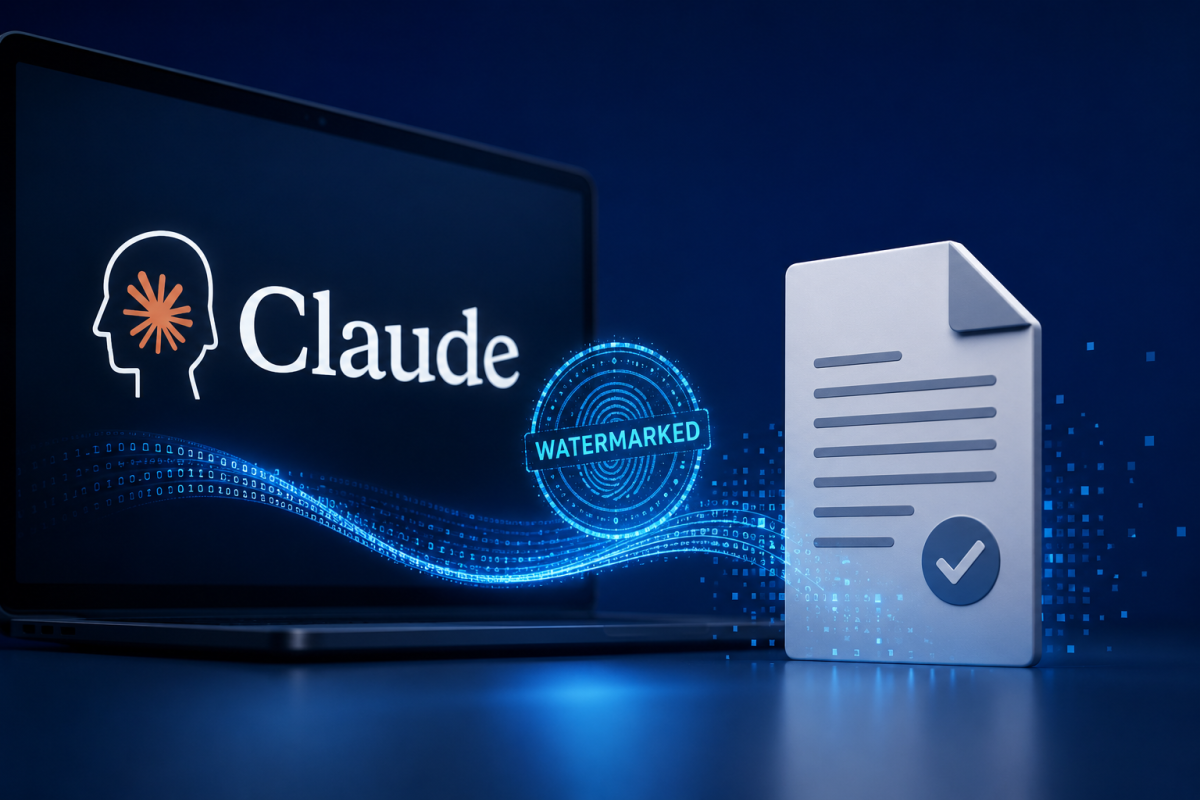
Hyderabad: Anthropic has begun introducing a new system designed to make Claude-generated content machine-detectable, marking a significant shift in how AI-generated text and files can be identified after they leave the Claude platform.
The company says supported Claude models now embed an imperceptible watermark directly into generated text. Unlike a conventional watermark or visible AI label, users will not see anything unusual in the text. The marking is designed to preserve the meaning, readability and quality of the response while potentially surviving copying, pasting and some editing.
What Exactly Is Being Added?
The important distinction is that Anthropic is not putting a visible “Generated by Claude” label on every paragraph.

Instead, the watermark is incorporated into the way the model generates the text. The resulting signal is intended to be detectable by specialised systems even though an ordinary reader cannot see it.
Anthropic says the marking is implemented at the model level, meaning it is intended to follow Claude-generated output regardless of whether the model is accessed through Claude’s consumer products, Claude Code, Cowork, the API or supported third-party cloud platforms.
The system is also being applied broadly rather than being limited to users in a particular country or region.
Files Will Use Digital Provenance
Claude’s file-generation capabilities are also part of the broader marking effort.
For supported generated files, Anthropic is using digitally signed provenance metadata based on the C2PA standard rather than relying solely on a text-style watermark.
C2PA is an open technical standard designed to record information about the origin and history of digital content. In the future, compatible software could potentially inspect a file and identify provenance information associated with its creation.
The approach is particularly relevant as Claude increasingly supports the creation and editing of files alongside coding, research and analysis capabilities.
Why Is Anthropic Doing This?
The move comes as governments and technology companies increasingly focus on transparency and provenance for AI-generated content.
One important development is the European Union’s AI Act, which introduces transparency obligations for providers of AI systems generating synthetic content. The broader objective is to make it easier for users and organisations to identify AI-generated material.
Anthropic’s watermarking system provides a technical mechanism through which AI-generated content can carry a signal that can potentially be detected by specialised systems.
However, the company is applying the technology more broadly than simply restricting it to one regulatory market.
How Could the Claude Watermark Work?
Anthropic has not publicly disclosed every technical detail of its implementation, but AI watermarking is an established area of research.
A language model can subtly modify its token-selection process so that the resulting text contains a statistical pattern known to a detection system. Because the changes are distributed throughout the generation process rather than displayed as an obvious symbol, the pattern can remain invisible to readers.
This means the approach is fundamentally different from simply adding hidden HTML, invisible characters or a visible label to a response.
The Watermark Is Not Foolproof
One of the biggest questions surrounding AI watermarking is how well the signal survives editing.
Extensive editing, paraphrasing, translation or combining Claude-generated material with independently written text can potentially weaken or remove the detectable signal.
This creates an important distinction: the detection of a Claude watermark could indicate that Claude generated or processed the content, but the absence of a watermark would not necessarily prove that Claude was not involved.
Research into AI text watermarking has also shown that different forms of rewriting and paraphrasing can affect the reliability of detection. The effectiveness of any particular watermark therefore depends heavily on the amount of original text that remains intact.
Criticism Over Possible Impact on Text Quality
Another debate among AI users and researchers is whether embedding a watermark during generation could have an effect on output quality.
Anthropic says the watermark is designed not to change the meaning, quality or readability of generated text. Critics, however, have questioned whether requiring a language model to satisfy an additional statistical constraint could potentially influence its token choices.
The concern is that the model would effectively have another hidden requirement to satisfy while generating a response.
At present, claims that the watermark has materially reduced Claude’s writing or coding quality should be treated as user criticism rather than an established fact. There is not enough evidence to conclude that the system causes a meaningful degradation in normal Claude usage.
Could This Affect Students, Writers and Publishers?
The technology could have significant implications for education, publishing and professional content creation.
Universities could potentially use future detection systems to investigate whether submitted material originated from Claude. Publishers could use provenance information when reviewing manuscripts or other content, while companies could potentially use it to establish whether documents were created or processed using AI.
However, provenance information would not necessarily reveal how much AI was involved. For example, a person could write an article themselves and use Claude only to edit a few paragraphs. A surviving watermark could show Claude involvement without proving that the entire article was AI-generated.
Current Claude Plans
Anthropic currently offers Claude across several consumer and business plans.
- Free: Claude is available without a subscription, with access to features such as web, mobile and desktop applications, web search, memory, file creation and code execution, subject to usage limits.
- Pro: The Pro plan is priced at $20 per month when billed monthly, or $200 annually. It provides higher usage limits and access to additional capabilities including Claude Code, Cowork and Research.
- Max: Max plans start at $100 per month, with higher-usage options providing substantially more usage than Pro.
- Team: Team plans are aimed at organisations and provide additional collaboration, administration and usage capabilities.
- Enterprise: Enterprise offerings provide organisation-wide administration, security and compliance features, with pricing depending on the arrangement and usage requirements.
AI Content Provenance Is Becoming a Bigger Industry Focus
Anthropic’s move is part of a wider industry effort to establish where AI-generated content came from.
Technology companies are increasingly experimenting with invisible signals, metadata and standards such as C2PA to establish the origin and history of digital content.
The idea is particularly important as AI-generated text, images, videos, software and documents become increasingly difficult to distinguish from human-created material.
What Happens Next?
The practical value of Anthropic’s watermarking system will depend on several factors, including how reliable detection becomes, how well the watermark survives editing and translation, and whether other AI companies adopt compatible provenance standards.
For Claude users, the development signals a broader change in AI-generated content. Content created with AI may increasingly carry an invisible digital provenance signal even after it has been copied into another application or document.
A watermark could make AI provenance easier to establish, but it is unlikely to become a perfect test for determining whether an entire piece of content was written by a human or generated entirely by AI.
For now, Anthropic’s move represents another major step toward making AI-generated content traceable, while also raising questions about privacy, detection accuracy, content ownership and how much AI involvement should be disclosed.