
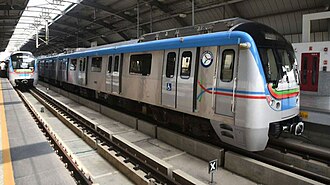
Chief Minister A. Revanth Reddy has traveled to New Delhi to seek the Centre’s approval for Telangana government’s proposal to acquire the existing 69.2-km Phase I Hyderabad Metro Rail (HMR) network from L&T Metro Rail Hyderabad Ltd. The government also aims to establish a joint venture with the Centre for the long-awaited Phase II expansion project. The proposed HMR Phase II network will span 122.9 km and requires an estimated investment of ₹38,595 crore. The plan involves equal equity participation from both the Centre and State governments, but progress has been stalled due to financial, regulatory and administrative challenges requiring multiple central approvals.
Government officials have stated that accessing low-interest funding for the acquisition or proceeding with metro expansion is not possible without clearances from the Centre. The Railway Act and Metro Rail Act mandate central involvement at various stages of metro rail development. Even when State governments develop metro rail systems, safety certification must be issued by the Commissioner of Metro Rail Safety (CMRS) under the Ministry of Civil Aviation. Senior officials explained that the CMRS officer is typically drawn from railway engineering services, making central coordination essential for project implementation.
The Chief Minister and senior officials have been making repeated representations to key ministries, particularly the Union Ministry of Housing and Urban Affairs (MoHUA), urging them to expedite necessary approvals. SBI Capital Markets (SBI Caps), which has been engaged by the government, is currently exploring options to secure a soft loan of approximately ₹13,500 crore through entities operating from Gujarat’s GIFT City. This marks Telangana’s second attempt to arrange financing for the takeover after an earlier proposal collapsed despite initial optimism.

The first financing attempt involved a ₹13,527-crore loan from the Indian Railway Finance Corporation (IRFC), which was announced with much fanfare in May but subsequently fell through. The proposal ran into trouble after the Ministry of Railways pointed out that IRFC’s mandate is restricted to financing new infrastructure projects and does not extend to refinancing existing assets. Officials have acknowledged uncertainty about how this fundamental limitation was overlooked during earlier discussions between the parties involved.
A high-level meeting held in June between Chief Minister Revanth Reddy and Union Ministers Ashwini Vaishnaw, G. Kishan Reddy and Manohar Lal Khattar raised hopes of a breakthrough. The meeting produced a roadmap aimed at resolving the impasse, which included appointing SBI Caps to identify a suitable lender willing to provide a soft loan to be serviced by the government rather than HMR. The proposed solution also involves merging Hyderabad Metro Rail with Hyderabad Airport Metro Limited (HAML), followed by the Centre acquiring a 50% stake in the unified metro entity. However, it remains unclear whether all Central ministries have formally approved the proposed funding model.
HMR authorities have expressed confidence in the plan, pointing to clearances obtained from the Reserve Bank of India (RBI) and statutory assurances required for the borrowing plan. The government is prepared to release its equity contribution of ₹1,462 crore to L&T, based on valuations conducted by IDBI Capital and DMRC International, once the loan is secured and SBI Caps confirms alignment with the valuation. Simultaneously, efforts are underway to procure 60 additional coaches for the existing metro network, though these acquisitions also require statutory clearances from agencies such as the Research Designs and Standards Organisation (RDSO) and the CMRS.
