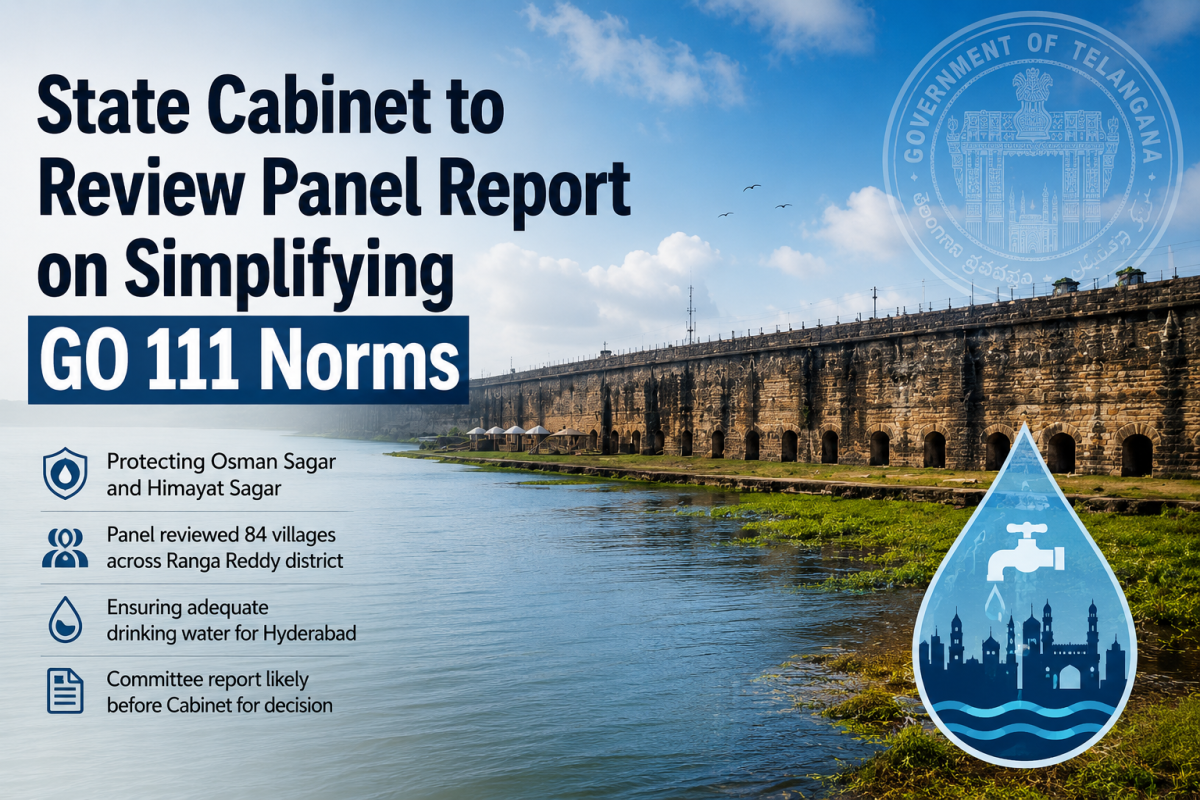
The Telangana Government is preparing to take a crucial decision on the future of GO 111, the decades-old order that restricts development in the catchment areas of Osman Sagar and Himayat Sagar. Chief Minister A. Revanth Reddy is expected to place the recommendations of a high-powered committee before the State Cabinet for consideration.
The committee was constituted to examine whether the existing restrictions can be relaxed without affecting the two reservoirs that remain important sources of drinking water for Hyderabad.
What Is GO 111?
Issued in 1996, GO 111 was introduced to protect Osman Sagar and Himayat Sagar from pollution and uncontrolled development. The order restricted polluting industries, large-scale construction, residential colonies and other activities in the designated catchment areas of the two reservoirs.

The order covers around 84 villages spread across nearly 1.32 lakh acres in areas including Shamshabad, Rajendranagar, Moinabad, Chevella and parts of the Rangareddy district.
The restrictions were intended to ensure that rainwater flowing into the reservoirs remained free from contamination and that Hyderabad’s drinking water sources were protected.
High-Powered Panel Suggests New Approach
The committee has reportedly recommended replacing the existing blanket restrictions with a more detailed land-use and zoning framework. The proposed approach would distinguish between environmentally sensitive areas, existing built-up locations and areas where controlled development could be permitted.
Under the proposed framework, development would not be treated uniformly across the entire GO 111 area. Instead, different regulations could apply depending on the location and its proximity to the reservoirs and their catchment areas.
Relaxation for Existing Built-Up Areas
One of the key recommendations concerns areas that have already witnessed significant development. The committee has suggested increasing the permissible built-up area in certain locations from the existing limit of around 10 per cent to as much as 40 per cent, while retaining substantial portions for open spaces and environmental safeguards.
The proposal is aimed at addressing the situation in villages and areas that have already experienced urbanisation despite the restrictions imposed under GO 111.
Officials and stakeholders have argued that continuing with a uniform ban across all locations has become increasingly difficult as Hyderabad’s urban footprint has expanded towards the ORR and beyond.
Focus on Catchment and Non-Catchment Areas
The committee has also recommended a scientific demarcation of catchment and non-catchment areas. Development regulations could consequently vary depending on whether a particular location directly contributes water to Osman Sagar or Himayatsagar.
Areas considered environmentally sensitive would continue to face stricter controls, while limited development could be considered in locations where the risk to the reservoirs is comparatively lower.
The recommendations reportedly include restrictions on activities that could affect the quality of water entering the reservoirs, along with stronger requirements for drainage, wastewater management and environmental protection.
Restrictions Proposed Around Reservoirs
The committee has recommended continued protection of the reservoir catchment areas, particularly zones that are considered ecologically sensitive. Construction and other activities in such locations would remain subject to strict scrutiny.
It has also suggested stronger safeguards for stormwater channels, natural drainage systems, open spaces and greenery so that development does not interfere with the flow of rainwater towards the reservoirs.
For permitted developments, measures relating to wastewater treatment and drainage infrastructure are expected to form an important part of the proposed regulatory framework.
Possible Changes to Development Pattern
The proposed framework could allow selected categories of development, including low-density residential activity, environmentally sustainable projects, communities and resorts, subject to the applicable conditions.
At the same time, the committee has reportedly recommended caution against uncontrolled high-density development and large concrete-intensive commercial projects in environmentally sensitive locations.
The objective is to allow Hyderabad’s growth to continue while preventing construction activity from putting additional pressure on its two important reservoirs.
Earlier Government Action on GO 111
The previous BRS government had announced the scrapping of GO 111 in 2022 and indicated that land-use regulations would subsequently be applied to the affected villages. However, the proposed replacement framework was not fully implemented.
After coming to power, the Congress government decided to examine the issue again. A high-powered committee was constituted in 2024 following legal and administrative developments surrounding the earlier decision.
The committee has now submitted its recommendations, setting the stage for the government to decide how development should be regulated in the region.
Cabinet Decision Could Shape Hyderabad’s Future Growth
The final decision will be significant for both landowners and developers in the areas covered by GO 111, as well as for the long-term water security of Hyderabad.
A relaxation of development restrictions could unlock large tracts of land for regulated development and provide greater clarity to property owners. At the same time, environmental safeguards will be critical to ensure that urban expansion does not compromise the reservoirs.
The State Cabinet is expected to examine the committee’s recommendations before deciding on the proposed regulatory framework. Any changes approved by the government could have a major impact on land use, real estate development and infrastructure planning across the areas surrounding Osman Sagar and Himayat Sagar.
Why the Decision Matters
- GO 111 covers around 84 villages across a large area around Hyderabad.
- The proposed framework could replace blanket restrictions with location-based land-use regulations.
- Existing built-up areas may receive greater development flexibility under controlled conditions.
- Catchment and non-catchment areas could have different development norms.
- Environmental safeguards, drainage, wastewater treatment and open spaces are expected to remain key conditions.
- The Cabinet’s decision could significantly influence real estate and infrastructure development in the affected areas.
For now, the committee’s recommendations remain subject to the government’s decision. The State Cabinet’s deliberations will determine whether Telangana moves towards a revised regulatory system for the GO 111 region and what conditions will govern development around Hyderabad’s twin reservoirs.