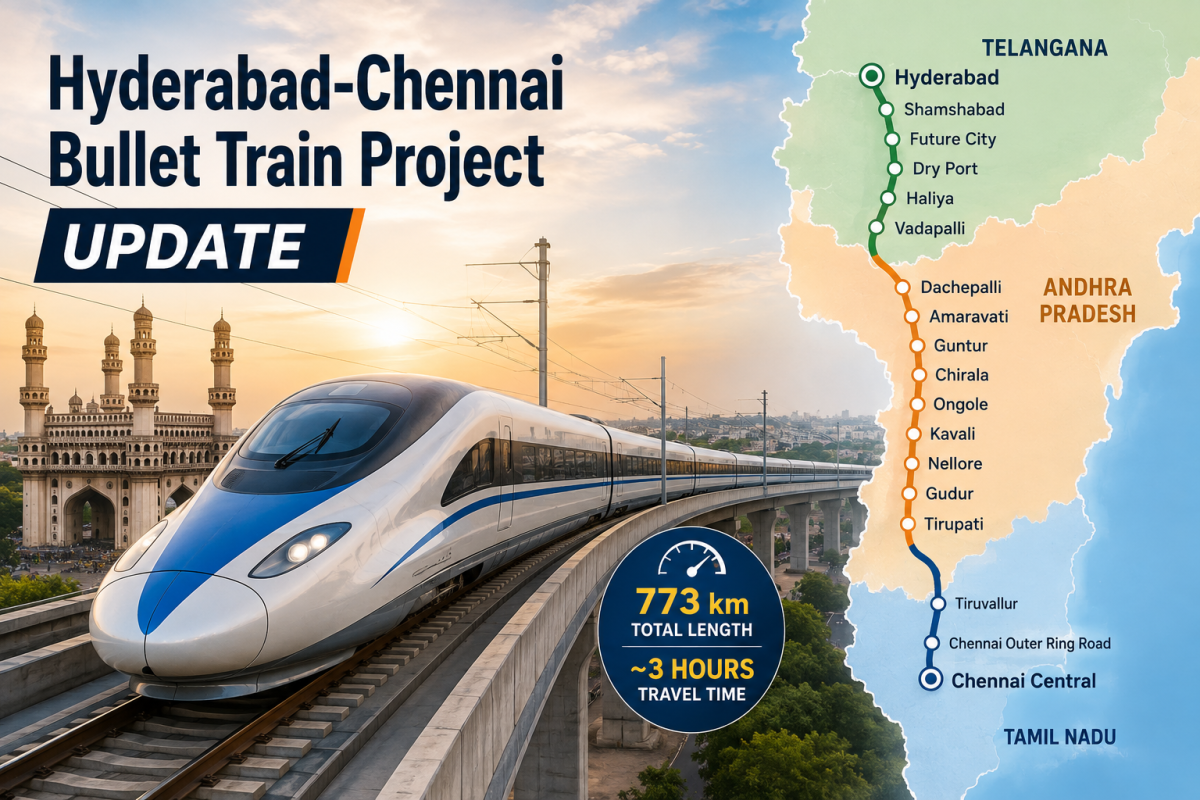
Hyderabad: The proposed Hyderabad–Chennai High-Speed Rail Corridor is taking shape with a revised alignment that is expected to strengthen connectivity between Telangana, Andhra Pradesh and Tamil Nadu. The latest route plans place important growth and pilgrimage centres, including Amaravati, Guntur and Tirupati, on the proposed high-speed rail network.
The corridor is one of the seven new high-speed rail corridors announced in the Union Budget 2026–27 as part of India’s plans to expand bullet train connectivity beyond the Mumbai–Ahmedabad project. The Centre has said the seven corridors together are expected to span around 4,000 km.
Revised Route Brings Future City and Dry Port Into Focus
The Hyderabad–Chennai corridor has undergone significant changes from its earlier alignment. The initial Telangana route was planned through areas including Batasingaram, Narketpally, Suryapet and Khammam. The revised alignment instead moves south from Shamshabad towards Bharat Future City, the proposed Dry Port, Halia and Vadapalli.

Reports in May and June said the Telangana portion of the proposed route was reduced from around 236 km to 123 km, with the revised alignment being surveyed by the National High Speed Rail Corporation Limited (NHSRCL). The changes are intended to better connect the corridor with Telangana’s planned Future City and proposed dry-port development.
The Telangana Government subsequently backed the revised alignment as part of a broader plan to integrate high-speed rail with the state’s future urban and logistics infrastructure.
Proposed Stations Across Three States
The latest route information circulating in August lists 18 proposed stations between Hyderabad and Chennai. The station locations are still subject to the detailed project and final approval process, so the list should not be treated as the final operational timetable.
Telangana
- Hyderabad
- Shamshabad
- Bharat Future City
- Dry Port
- Halia
- Vadapalli
The revised Telangana alignment is particularly significant because it connects the proposed high-speed rail system with Bharat Future City and the planned dry-port project rather than following the earlier route through Narketpally, Suryapet and Khammam.
Andhra Pradesh
- Dachepalli
- Amaravati
- Guntur
- Chirala
- Ongole
- Kavali
- Nellore
- Gudur
- Tirupati
Amaravati and Tirupati are among the most notable additions to the proposed route. Earlier reports said Andhra Pradesh had requested that the corridor be routed through the Amaravati region to improve access to the state’s capital area. NHSRCL subsequently gave a favourable response to the proposal, according to reports.
Tamil Nadu
- Tiruvallur
- Chennai Outer Ring Road
- Chennai Central
The proposed Chennai-side alignment is expected to approach the city through Tiruvallur and the Chennai Outer Ring Road before terminating at Chennai Central.
Corridor Length: 760 km or 773 km?
There are currently different figures being reported for the overall length of the proposed corridor. A June report citing the proposed Hyderabad–Amaravati–Chennai alignment put the length at 760.09 km, comprising about 180.32 km in Telangana, 518.54 km in Andhra Pradesh and 61.23 km in Tamil Nadu.
A more recent route update circulating in August puts the corridor at approximately 773 km. The difference appears to reflect changes in the alignment and the stage of project planning. The final figure will become clearer once the detailed alignment and DPR are formally finalised.
Hyderabad–Chennai Journey Could Fall Dramatically
The proposed high-speed rail network is aimed at substantially reducing travel time between major southern cities. Earlier reports on the Hyderabad–Amaravati–Chennai corridor estimated that the Hyderabad–Chennai journey could take around 2 hours and 20 minutes on the fastest services. Other current reports have described the expected journey time as approximately three hours.
The actual journey time will depend on the final operating pattern, number of intermediate stops and train schedules. Not every service would necessarily stop at every proposed station.
Tirupati Could Become a High-Speed Rail Junction
The proposed inclusion of Tirupati could give the temple city an important position in the emerging southern high-speed rail network.
In addition to the Hyderabad–Amaravati–Chennai corridor, NHSRCL has agreed to conduct a final location survey and prepare a DPR for a proposed 65-km Chittoor–Tirupati high-speed rail link. The proposed link would connect the Hyderabad–Chennai corridor with the Chennai–Bengaluru High-Speed Rail Corridor, creating another potential route between Andhra Pradesh, Tamil Nadu and Karnataka.
Part of India’s Larger High-Speed Rail Expansion
The Hyderabad–Chennai project is part of a much larger expansion of India’s high-speed rail network. The Union Budget 2026–27 announced seven new high-speed corridors, with the government estimating that the planned network could involve about 4,000 km of high-speed rail infrastructure and attract significant investment.
The Railway Ministry has also said that India is developing a standardised approach for future high-speed rail projects based on experience gained from the Mumbai–Ahmedabad High-Speed Rail project. The Mumbai–Ahmedabad corridor is designed for operations at up to 320 kmph, while the new corridors are expected to benefit from standardised designs, construction methods and maintenance practices.
What Happens Next?
Despite the latest alignment developments, the Hyderabad–Chennai corridor remains a proposed high-speed rail project. Detailed surveys, preparation of the DPR, final alignment approval, land acquisition and other statutory clearances will be required before construction can begin.
For Telangana, the revised route could be particularly significant as it places Shamshabad, Future City and the proposed Dry Port within the state’s emerging high-speed transport and logistics network. For Andhra Pradesh, the proposed connection through Amaravati, Guntur and Tirupati could provide a new high-speed link between the state’s major administrative, commercial and pilgrimage centres.
If the proposed alignment and operating plans are ultimately approved, the Hyderabad–Chennai corridor could become one of the most important high-speed rail links in southern India, connecting three states and creating a faster passenger network between some of the region’s largest cities.
Note: Station locations, corridor length and travel-time figures mentioned above are based on the latest reported proposals and may change during the final survey, DPR preparation and approval process.