At Telangana Tribune, we believe that the future of journalism, literature, and public discourse lies in the ideas and voices of young people. As part of our commitment to encouraging emerging talent, we are pleased to provide a platform for students to share their perspectives on issues that matter to society.
Through this initiative, Telangana Tribune aims to spotlight thoughtful articles written by school and college students across Telangana and beyond. Whether it’s social issues, technology, education, environment, culture, or personal experiences, we want young writers to express their ideas and engage with a wider audience.
Today’s guest article has been written by Tayaba Fathima, a second-year BBA Business Analytics student at St. Mary’s Centenary Degree College, Secunderabad. Tayaba has a keen interest in writing opinion pieces that explore contemporary social issues, human behaviour and the changing dynamics of modern society. Through her writing, she hopes to encourage readers to reflect, question and engage in meaningful conversations.

In this thought-provoking article, she reflects on one of the defining challenges of the digital age—how constant online connectivity can still leave people feeling emotionally disconnected. Her article explores the growing issue of loneliness in an increasingly connected world and encourages readers to value meaningful human relationships.
Connected to Everyone, Close to No One
By Tayaba Fathima
The following article is published as submitted by the author.
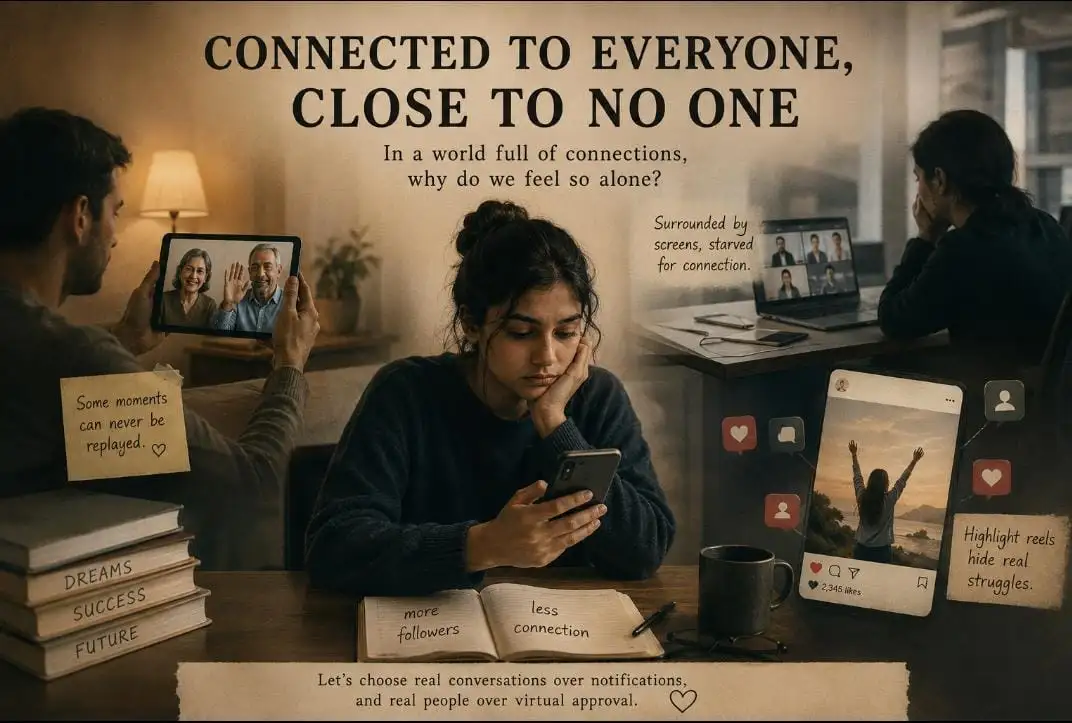
A son video-calls his parents every night from another city, yet misses sitting beside them at the dinner table. A young professional spends an entire day in virtual meetings but returns to an empty apartment where silence greets them. A student has over 2,000 followers on Instagram, yet hesitates before calling a friend when life becomes overwhelming.
Different people. Different lives.
One common feeling—loneliness.
It is the quiet epidemic of our time, hiding behind endless notifications, busy schedules and carefully curated online lives.
Never before have we had so many ways to communicate. A message reaches another continent in seconds. A video call brings faces together despite thousands of kilometres. Social media allows us to share our lives with hundreds, sometimes thousands, of people at once. Yet, despite living in the most connected era in human history, many people have never felt more emotionally disconnected.
Somewhere along the way, we began confusing communication with connection. We reply with emojis instead of emotions, react to stories instead of asking, “How are you really doing?”, and mistake being constantly online for having meaningful relationships. We know what someone had for dinner, where they travelled and what achievements they celebrated, but often have no idea how they are coping behind the smile in their latest photograph.
This generation is often praised for dreaming big—and rightly so. Young people are willing to leave their homes, families and even countries in pursuit of education, careers and better opportunities. Parents encourage their children to build lives they themselves could only imagine. New cities promise fresh beginnings, exciting careers and brighter futures.
But every opportunity comes with a price.
What is rarely discussed is the emotional cost of success.
The first birthday celebrated through a phone screen.
The first festival where an empty chair at the dining table quietly reminds a family that someone is missing.
The first time “I’m fine” becomes the easiest answer, even when it is the furthest thing from the truth.
Distance changes relationships in ways that often go unnoticed. Parents grow older while children grow busier. Friends who once spent every evening together now struggle to find an hour in an entire month. Home slowly becomes a place visited during holidays rather than a place where life happens every day. Some of life’s biggest milestones are now witnessed through screens, while the small everyday conversations that once strengthened relationships quietly disappear.
The modern workplace tells a similar story. Offices once filled with spontaneous conversations are increasingly replaced by laptops, headphones and virtual meetings. Remote work has created remarkable flexibility and opened doors to opportunities that were once unimaginable. Yet for many people, it has also reduced the simple human interactions that quietly shape our emotional well-being. Someone may confidently present ideas to dozens of colleagues through a webcam and still feel anxious introducing themselves to a stranger in person. Technology makes communication efficient, but genuine connection still depends on presence, empathy and shared experiences.
Social media adds another layer to this paradox. Every scroll presents carefully selected moments of success, celebrations and happiness. Rarely do we see rejection, loneliness, uncertainty or failure. As a result, many people begin comparing their ordinary lives with everyone else’s highlight reel. The more we compare, the easier it becomes to believe that everyone else is happier, more successful and more fulfilled. In trying to stay connected with everyone, we often become disconnected from ourselves.
This is no longer simply a personal observation. The World Health Organization has recognised loneliness and social isolation as growing public health concerns because of their impact on both mental and physical well-being. Research continues to show that meaningful relationships improve happiness, resilience and overall quality of life. Technology can help us stay in touch, but it cannot replace the comfort of sitting beside someone who truly listens.
The solution is not to abandon technology, delete social media or stop chasing opportunities. Progress has transformed lives, and ambition should never be discouraged. The real challenge is ensuring that, while building successful careers and connected digital lives, we do not quietly lose the relationships that give those achievements meaning.
Perhaps it begins with small choices. Calling our parents without checking the time. Meeting friends without reaching for our phones every few minutes. Asking someone, “How are you?”—and waiting patiently to hear the real answer. Choosing conversations over notifications, presence over convenience and people over algorithms.
Because one day we may realise that the greatest luxury was never high-speed internet, artificial intelligence or endless online connectivity.
It was having someone who knew us beyond our profile, beyond our achievements and beyond our carefully chosen words.
In a world becoming smarter and faster every day, perhaps the greatest measure of success is not how many people know our name, but how many people truly know our heart.
— Tayaba Fathima
Editor’s Note: Telangana Tribune is proud to support and encourage aspiring student writers. If you are a student with an original article, opinion piece or feature story that you would like to share with our readers, you can send your submission to our editorial team for consideration. Selected articles will be published with full credit to the author.