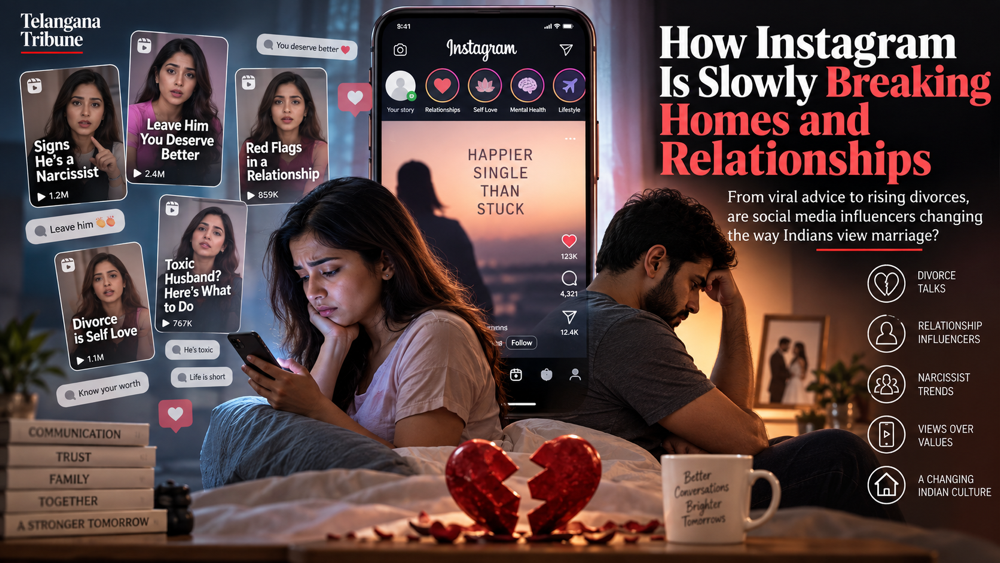
HYDERABAD: A relationship problem that once stayed between a couple, their families or a trusted counsellor can now become a 30-second Instagram Reel.
Scroll through social media today and it is easy to find videos telling people how to identify a “narcissist”, when to leave a husband or boyfriend, why an argument is a “red flag”, or why staying in a difficult relationship means compromising one’s self-respect. Some of this content can be genuinely useful. But there is another side to the trend: complex relationships are increasingly being reduced to short, emotionally charged pieces of content designed to attract views, shares and followers.
That raises an uncomfortable question for Indian families: when relationship advice becomes entertainment, can social media influence decisions that were once made after much deeper consideration?
Every Relationship Is Becoming a 30-Second Story
Instagram’s short-video format rewards content that immediately captures attention. A complicated marriage involving years of shared experiences, children, financial responsibilities, family relationships and personal circumstances cannot easily be explained in a Reel.
Instead, the viewer may get a simple message: “If he does this, leave him”, “These are five signs of a narcissist”, or “Never tolerate this in a relationship”.
The problem is not that people should tolerate unhealthy or abusive relationships. People facing genuine abuse, violence, coercive control or serious harm should have access to appropriate professional and legal support.
The concern is that a short video cannot know the circumstances of the person watching it.
The Algorithm Has No Knowledge of Your Marriage
An Instagram recommendation system does not know the history of a couple’s relationship. It does not know whether an argument was an isolated incident or part of a long-term pattern. It does not know whether both partners have tried counselling, whether there are children involved, or whether the couple is dealing with financial, family or emotional pressures.
It primarily responds to patterns of engagement.
Research published in Nature Human Behaviour has found that negative and emotional language can increase consumption of online content. In one large experiment involving viral news stories, researchers found that each additional negative word in an average-length headline increased click-through rates by about 2.3%.
Other research has similarly examined how social-media environments can amplify emotional expressions. Researchers have pointed to the way engagement-driven systems can increase people’s exposure to emotionally charged and moralised material.
That does not mean Instagram deliberately promotes divorce or wants families to break apart. It means that content capable of generating a strong reaction can have an advantage in an attention-based environment.
“Narcissist” Has Become a Social-Media Buzzword
One of the clearest examples is the explosion of relationship content built around words such as “narcissist”, “toxic”, “gaslighting”, “red flag” and “emotional abuse”.
These concepts can describe real psychological or relationship problems. But on social media, they are sometimes used much more broadly.
A husband who disagrees with his wife, a boyfriend who does not respond immediately to messages or a partner who makes a mistake can potentially be portrayed as evidence of a much larger personality problem.
That is where online advice can become dangerous: a diagnosis or serious psychological label cannot reliably be made from a few sentences in a Reel.
Even genuine relationship difficulties require context. Professional assessment is very different from watching several videos and deciding that a partner fits a particular label.
Influencers Can Become Unofficial Relationship Counsellors
The influencer economy has created a new category of online advice-giver. Some creators are qualified psychologists, counsellors or therapists and clearly identify their professional credentials. Others are relationship creators whose authority comes primarily from their personal experiences or social-media following.
For a viewer going through a difficult period, the difference may not always be obvious.
A creator with millions of followers can appear more convincing than a qualified professional with a small online presence simply because the influencer’s videos are more polished, emotional and frequently recommended.
Research on influencer culture has also examined the parasocial relationships that followers develop with online personalities. An Indian Express report discussing research involving 500 Instagram users noted that stronger attachments to influencers and their communities can be associated with problematic engagement.
That creates an important distinction: having a large following does not automatically make someone qualified to advise a stranger on whether to stay married, separate or divorce.
“Leave Him” Is Easy Advice. Living With the Decision Is Not.
A social-media creator can make a video in less than a minute. The person watching it may live with the consequences for decades.
Marriage decisions can involve children, housing, finances, elderly parents, employment, immigration status, family relationships and emotional history. In India, family relationships can also involve a wider network of parents, siblings and relatives.
None of that fits neatly into a 30-second video.
This is particularly important when someone watches relationship content while they are angry or emotionally overwhelmed. A video that appears to describe their situation perfectly may encourage them to interpret every disagreement through the same lens.
Social Media Can Also Help People
The discussion should not become an argument against Instagram or online relationship education.
Social media has made information about domestic violence, emotional abuse, counselling, legal rights and mental health more accessible than it was for many people in the past.
Someone experiencing genuine abuse may find the courage to seek help after recognising behaviour they had previously normalised. Online communities can also help people feel less isolated.
The issue is therefore not whether relationship content should exist. The more important question is how responsibly that content is created and consumed.
Indian Relationships Are Also Changing
India’s younger generations are navigating relationships differently from previous generations. Greater financial independence, urbanisation, changing expectations around marriage, women’s participation in the workforce and wider access to information are all influencing family life.
Social media is part of that wider transformation, but it should not be treated as the single cause of changing attitudes towards marriage.
At the same time, Indian social life has traditionally placed considerable importance on family relationships and marriage. That can make online relationship advice particularly complicated. A message that promotes individual autonomy may be empowering for one person while appearing completely disconnected from another person’s cultural or family circumstances.
The Bigger Problem May Be Comparison
Relationship content does not only tell people what to do. It can also change what they expect from their own partner.
Instagram is filled with carefully edited images of couples travelling together, buying gifts, celebrating anniversaries and constantly expressing affection.
Real relationships, meanwhile, contain ordinary days, disagreements, responsibilities, financial pressures and periods when neither person feels particularly romantic.
Research on Instagram Reels has also found associations between greater Reels engagement, anxiety and lower well-being in one cross-sectional study, with social comparison playing a role in the relationship between Reels use and anxiety. The study does not establish that Instagram causes these outcomes, but it highlights the importance of how highly curated social-media environments can affect users.
Not Every Marriage Problem Means the Marriage Is Over
This is perhaps the most important distinction missing from some viral relationship content.
A disagreement does not necessarily mean a relationship is toxic. A period of emotional distance does not automatically mean that a marriage has failed. And a partner making a mistake does not necessarily indicate a personality disorder.
Equally, serious abuse should not be dismissed as “just a phase”.
The challenge is knowing the difference.
That is where qualified counsellors, psychologists, lawyers and other appropriate professionals can provide context that a social-media algorithm cannot.
Couples Need More Than Viral Advice
There is nothing wrong with learning about relationships online. But viral advice should be treated as a starting point for reflection, not as a professional assessment or an instruction manual for someone’s marriage.
Before making a major decision based on something seen online, people should ask a few basic questions:
- Is the person giving the advice professionally qualified?
- Is the video describing a general possibility or diagnosing my specific partner?
- Could there be another explanation for what is happening?
- Am I watching this because it is genuinely useful, or because I am already angry and the video confirms what I feel?
- Have I discussed the situation with someone trustworthy who knows the circumstances?
- If the situation is serious, have I considered professional counselling or appropriate legal support?
The Business of Attention
There is also an economic reality behind social-media content.
Creators compete for views, followers, advertising revenue, sponsorships and brand partnerships. Content that makes people stop scrolling, comment, share or watch until the end has an obvious advantage.
Research has repeatedly found that negative and emotionally charged content can attract attention online. That does not prove that individual influencers deliberately try to damage relationships for money, but it does explain why extreme and emotionally provocative messages can become highly visible.
The incentive structure is therefore worth understanding: the creator’s business may depend on keeping the viewer emotionally engaged, while the viewer may be making decisions about a real relationship.
Instagram Cannot Know What Happens Behind the Door
The most important thing to remember is that a social-media feed shows fragments.
It may show a person’s story, a creator’s interpretation or a stranger’s experience. It cannot see the entire relationship.
For some people, online content may be the first step towards recognising abuse and seeking help. For others, repeatedly consuming one-sided relationship content may reinforce suspicion, anger or unrealistic expectations.
The answer is not to blame Instagram for every divorce, nor to dismiss legitimate concerns about unhealthy relationships. It is to recognise that a platform built around attention is not the same thing as a relationship counsellor.
As relationship advice increasingly becomes part of India’s social-media culture, users may need something that the algorithm cannot provide: context, patience and the willingness to understand an entire relationship before making a life-changing decision.