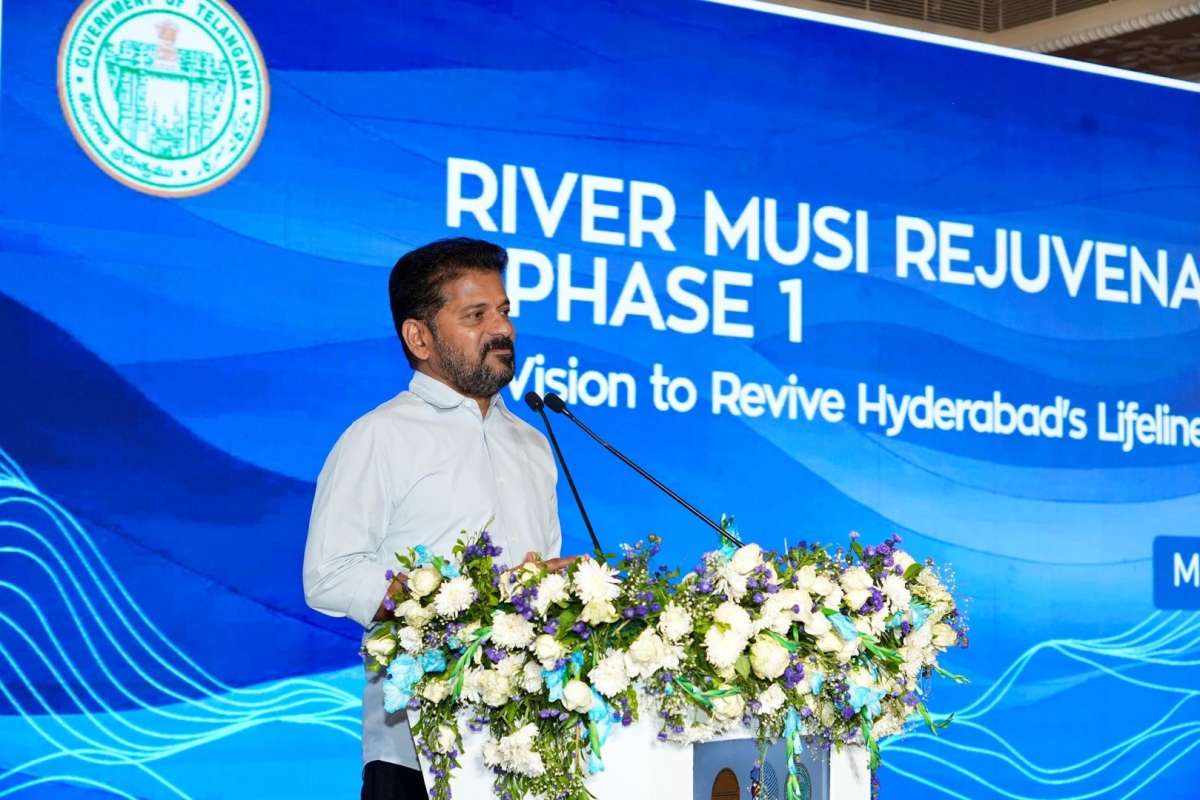
Hyderabad – Chief Minister A. Revanth Reddy addressed concerns surrounding the Musi rejuvenation project at the MUSI INVITES programme, stating that some groups are deliberately spreading misinformation and half-truths about the initiative. The Chief Minister emphasised that the government organised this programme to present factual information to the public and clear misconceptions about the project’s objectives.
The Chief Minister highlighted that the government views power as a responsibility to serve as a guardian for the people, not as a tool for domination. He stressed that human civilisation has historically developed around rivers and warned that if Telangana fails to progress while the rest of the world moves forward, future generations will not forgive the current leadership. He revealed that the government has already consulted intellectuals and experts from various sectors to gather comprehensive suggestions for the development plan.
Recalling the devastating 1908 Musi floods that destroyed much of Hyderabad, Revanth Reddy noted how the Nizam consulted renowned engineer Mokshagundam Visvesvaraya and subsequently constructed Himayat Sagar and Osman Sagar reservoirs to control flooding. These reservoirs have protected the city from floods and provided drinking water to residents for more than a century, demonstrating the importance of visionary infrastructure projects.

The Chief Minister questioned why those who ruled the state for ten years are now opposing the Musi rejuvenation project, asking whether such a historically rich city should be left neglected. He urged critics to offer constructive suggestions if they identify any shortcomings rather than simply obstructing development. He pointed out that despite changes in governments since 1994, Hyderabad’s development has never stopped, and only leaders with vision who prepare long-term development plans are remembered in history.
Addressing the environmental crisis, the Chief Minister stated that the Musi River has become highly polluted, causing suffering in areas like Nalgonda district. Though the river originates in Rangareddy district, it becomes heavily contaminated by the time it reaches Hyderabad. He also referred to the historical significance of the confluence of the Musi and Esi rivers, where Mahatma Gandhi’s ashes were immersed at Bapu Ghat, questioning how many tourists visit the site today.
The Chief Minister clarified that the project is not merely about cleaning a river but about protecting the city’s culture, history, and environment. As part of this effort, lakes such as Nalla Cheruvu, Bathukamma Kunta, and Bamrook-ud-Daula Lake have already been restored. He challenged critics who claim bulldozers are being sent into Musi’s catchment areas, stating the government is only implementing laws enacted by the Centre. He even offered to provide container housing with full facilities for three months to those opposing the project so they could experience the conditions in the polluted Musi basin firsthand.
Revanth Reddy questioned why development should be obstructed and asked whether the poor should be denied proper infrastructure, employment opportunities, tourism growth, and the benefits of a night economy. He dismissed allegations that the project is about beautification or profiteering, clarifying that the initiative is aimed at long-term public benefit. He warned that if the present generation fails to achieve even ten percent of what the Nizam accomplished for Hyderabad, history will not forgive them.
Quoting Mahatma Gandhi’s philosophy of winning great struggles through peace, the Chief Minister said the responsibility lies with the present generation to carry forward those ideals and protect the city’s heritage. He asserted that the Musi rejuvenation project is not against anyone and not intended to seize anyone’s property, but is meant for the welfare of future generations and the protection of nature and the environment.