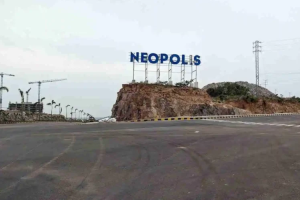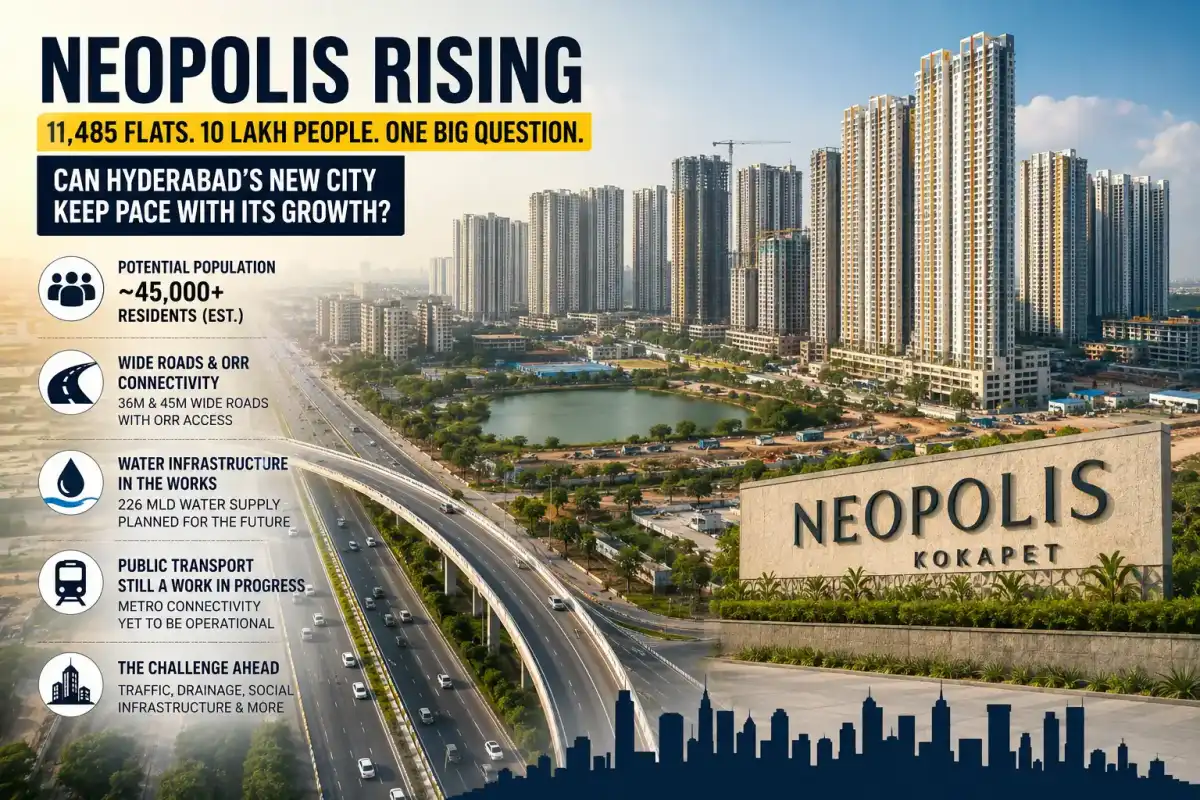
HYDERABAD: Neopolis in Kokapet is no longer just a collection of luxury apartment projects. With thousands of homes rising across a master-planned precinct, the area is gradually taking the shape of a new high-density urban district on Hyderabad’s western edge.
A project summary reviewed by Telangana Tribune lists 14 residential developments with a combined 123.44 acres and 11,485 apartments. The list includes My Home Nishada, Sattva LakeRidge, Rajapushpa Casa Luxura, Prestige Clairemont, Brigade Gateway, One by MSN, The Cascades, Rajapushpa Skyra, Sattva Lago, NEO by Yula, Rise With 9 – Trilight Residences, My Home Grava, My Home 99 and Brigade Barcelona.
These numbers raise a bigger question than how many luxury apartments are coming up: how will Neopolis function once thousands of families actually begin living there?
Neopolis is entering a new phase of development, with thousands of apartments planned across multiple high-rise residential projects. A project summary covering 14 upcoming residential developments lists a combined 123.44 acres of residential land and 11,485 apartments. If the homes eventually average three to four occupants each, these projects alone could accommodate roughly 34,000 to 46,000 residents. The wider Neopolis master plan is significantly larger, however, and government planning has already considered infrastructure requirements for a much bigger future population.
| Neopolis Residential Pipeline | Figures |
|---|---|
| Residential projects | 14 |
| Total residential land | 123.44 acres |
| Total apartments | 11,485 units |
| Estimated population at 3 persons/home | ~34,455 |
| Estimated population at 4 persons/home | ~45,940 |
| Wider Neopolis planning area | ~530 acres |
| Planned bulk water capacity | 226 MLD |
| Planned sewage treatment capacity | 45 MLD |
| Planned road widths | 36 m and 45 m |
These population figures are illustrative estimates rather than official population forecasts. Actual occupancy will depend on household size, investor-owned units, rental occupancy and the pace at which individual projects are completed. The wider infrastructure plans indicate that authorities are preparing for a much larger urban population in the longer term, making traffic management, public transport, water supply, sewage, stormwater drainage and social infrastructure critical to how successfully Neopolis develops into a functioning urban district.
11,485 Flats Could Mean a Population the Size of a Small City
The 11,485 apartments in the project summary are not the same thing as 11,485 residents. A more useful way to look at the number is to estimate the eventual household population.
Telangana’s 2011 Census data put the state’s average household size at approximately four people per household.
If that benchmark is applied simply as a planning illustration, 11,485 occupied homes could eventually represent around 45,940 residents.
Even with a smaller average of three people per apartment, the population would still be around 34,455 people.
In other words, the residential pipeline shown in the project summary alone could eventually accommodate a population roughly comparable to a small Indian town.
And this is only the residential pipeline captured in the supplied 14-project list. Neopolis itself is a much larger development.
Neopolis Is Planned as a 530-Acre Urban Precinct
The Neopolis master-planned area covers approximately 530 acres and is being developed as a mixed-use urban district, with residential, commercial, hospitality, healthcare and entertainment uses planned within the larger precinct. The layout includes wide internal roads and underground utility infrastructure.
That distinction is important. The 123.44 acres in the residential-project summary should not be treated as the total size of Neopolis. A large part of the wider master plan will eventually accommodate roads, open spaces, utilities and non-residential development.
That also means the eventual population and daily movement in Neopolis could be substantially higher than the residential numbers alone suggest.
The Bigger Number: Government Planning for Up to 10 Lakh People
In March 2026, The New Indian Express reported that the Greenfield Township in Neopolis was expected to house around 10 lakh people over the following six to seven years, with water infrastructure being planned for a maximum population of approximately 12.8 lakh.
That figure covers a much broader future development scenario than the 11,485 flats listed in the residential summary. But it shows the scale at which authorities are thinking about the area.
Neopolis is therefore not being planned merely as another apartment cluster. At full build-out, it could function as a major urban population and employment node connected to the Financial District, Kokapet, Narsingi and the Outer Ring Road.
Water Infrastructure Is Already Being Planned at City Scale
The expected population has forced water planning to move well beyond the requirements of individual apartment communities.
HMWSSB has proposed a 226 million litres per day (MLD) bulk water supply system and a 45 MLD sewage treatment plant for the Neopolis area, at an estimated project cost of around ₹298 crore, according to The New Indian Express.
The proposed system includes large-diameter water mains, reservoirs, pumping infrastructure and associated utility works. The infrastructure is being planned for a service population of up to 12.8 lakh.
This is an important development because water availability is one of the biggest questions facing rapidly urbanising western Hyderabad. Residents in Kokapet have already raised concerns about drinking-water supply, sewerage and other civic infrastructure.
The Road Network Looks Strong on Paper
One of Neopolis’ biggest advantages is that it was planned before the current wave of construction, rather than emerging entirely through incremental development.
The master-plan infrastructure includes 36-metre and 45-metre-wide roads, equivalent to roughly 118 feet and 148 feet respectively. The layout also has a dedicated trumpet-style connection to the Outer Ring Road.
This is considerably different from older Hyderabad neighbourhoods where roads were often widened after buildings and communities were already established.
But wide roads do not automatically mean congestion-free roads.
Where the Traffic Problem Could Begin
The likely challenge is not simply road width. It is the number of vehicles attempting to use the same network during the same peak periods.
If 11,485 homes eventually reach full occupancy and even 1.2 cars are associated with each household, the residential communities alone could represent approximately 13,800 private cars.
At 1.5 cars per household, the figure rises to roughly 17,200 cars.
These are not forecasts of actual registrations. They are scenario calculations to illustrate the scale of the potential vehicle population. Luxury housing can also generate significant visitor, domestic-worker, delivery, school, taxi and service traffic that is not captured by a household-car calculation.
The critical question, therefore, is whether the wider road network can distribute these vehicles efficiently during the morning and evening peaks.
ORR Connectivity Is Both an Advantage and a Pressure Point
Neopolis has an unusual advantage: direct access to the Outer Ring Road through a dedicated interchange. That gives residents fast regional connectivity to the airport and other parts of Hyderabad.
But the ORR connection also concentrates traffic. When a large number of residential communities depend on the same entry and exit points, congestion can shift from the apartment roads to the interchange, feeder roads and nearby junctions.
Residents in the broader Kokapet area have already complained about traffic, road conditions, road-widening works and construction-related disruption.
This could become more important as more towers move from construction sites to occupied communities.
Thousands of Homes Mean Thousands of Daily Trips
A residential population does not remain inside its apartment complex throughout the day.
Children travel to schools. Residents commute to offices. Domestic workers and maintenance staff enter and leave. Food deliveries, e-commerce, cabs, school buses, waste collection vehicles and service providers add another layer of movement.
Neopolis is particularly exposed to this because a significant share of its residents are likely to work in the surrounding western Hyderabad employment belt.
The Financial District, HITEC City and other major employment centres are relatively close, but most daily commuting currently remains heavily dependent on roads.
The Missing Piece: Mass Transit
For a development of this scale, public transport becomes increasingly important.
As of 2026, Neopolis does not have an operational metro station. Future metro connectivity has been discussed and planned for the western Hyderabad corridor, but residents cannot currently depend on metro rail for their daily commute.
This distinction matters because future metro connectivity is frequently included in the investment narrative around Kokapet. The actual benefit, however, will depend on funding, construction and eventual operations.
Until that happens, the majority of daily trips are likely to continue relying on private cars, cabs, buses and two-wheelers.
What About FSI and High-Rise Density?
The skyline emerging in Neopolis is another indication of the area’s unusually high development intensity.
Several projects are planned as high-rise developments. For example, an HMDA technical approval for one Neopolis residential-commercial project allows towers reaching 54 upper floors, demonstrating the vertical nature of development in the precinct.
However, it would be misleading to calculate the FSI of the entire Neopolis residential pipeline simply by dividing 11,485 units by 123.44 acres.
FSI/FAR is calculated from permissible or applicable floor area relative to the plot area, not from the number of apartments. The project summary provided to us does not contain the sanctioned built-up or floor-area figures for all 14 developments, so a precise combined FSI cannot responsibly be stated.
What can be said is that the combination of large residential towers, relatively compact development parcels and thousands of apartments represents a high-density vertical urban model.
Density Is Not Necessarily the Problem
High density by itself is not necessarily bad urban planning.
In fact, dense development can make public transport, retail, schools and other services more viable because more people live within a smaller geographic area.
The problem arises when population density grows faster than transport, water, sewage, pedestrian infrastructure and social infrastructure.
Neopolis has an opportunity that many older parts of Hyderabad did not have: much of its trunk infrastructure can be planned before the population arrives.
The Social Infrastructure Question
One of the less discussed issues is what happens outside the apartment gates.
Luxury projects typically provide extensive clubhouses, gyms, swimming pools, sports facilities and internal amenities. But a functioning city also needs schools, clinics, hospitals, supermarkets, neighbourhood retail, parks, pedestrian routes, public spaces and emergency services.
The wider Neopolis plan reportedly earmarks land for social infrastructure, while the master plan allows mixed-use development including healthcare, hospitality, retail and entertainment.
The challenge will be ensuring that these facilities arrive alongside the residential population rather than years after thousands of families have moved in.
Construction Could Remain a Problem for Years
There is another unavoidable phase between the present and the finished Neopolis: construction.
With multiple large residential developments being built simultaneously, the area is likely to experience construction traffic, heavy vehicles, dust and temporary road diversions for an extended period.
Residents in Kokapet have already complained about dust from construction-material transport and excavation, poor roads, sewerage problems, water shortages and urban flooding.
Those problems may reduce as individual projects are completed, but the construction cycle could continue as new towers and commercial developments are added.
Urban Flooding and Drainage Need Attention
Water supply gets much of the attention, but storm-water management is equally important for a rapidly built-up district.
Large apartment towers replace previously undeveloped land with buildings, basements, paved roads and other hard surfaces. If storm-water systems do not expand at the same pace, intense rainfall can quickly overwhelm local drainage.
Residents have already raised concerns about urban flooding and drainage in the wider Kokapet area.
For a development expected to house tens of thousands of residents — and potentially far more people under the broader Neopolis growth scenario — drainage capacity will need to be treated as core infrastructure rather than an afterthought.
Neopolis Has One Major Advantage: It Can Still Plan Ahead
Despite these concerns, Neopolis is not starting from the same position as an old, congested neighbourhood.
The development has a master plan, large land parcels, planned road hierarchy, underground utility provisions, ORR connectivity and designated infrastructure zones.
That creates an opportunity for the authorities and developers to anticipate the population rather than react to it.
The key priorities should be clear: complete the road network before occupancy peaks, strengthen sewage and stormwater systems, secure long-term water supply, create convenient public transport, provide pedestrian infrastructure and ensure schools, healthcare and everyday retail grow alongside housing.
The Real Test Begins When People Move In
For years, Neopolis has been presented primarily through its skyline, lake views, luxury apartments and record land prices. The next phase will be less glamorous but far more important: making the district work as a city.
The 14 residential projects in the supplied pipeline alone represent 11,485 homes across 123.44 acres. Using Telangana’s historical four-person household benchmark as a simple planning illustration puts the potential residential population at nearly 46,000 people.
And that is only one slice of the larger Neopolis development, for which authorities have already been planning water infrastructure at a scale capable of serving a much larger future population.
Neopolis may well become one of Hyderabad’s most important new urban districts. The question is no longer whether the towers will come up. The more important question is whether the infrastructure outside those towers will be ready when tens of thousands of people start calling them home.
Editor’s note: The 123.44-acre/11,485-unit project figures in this analysis are based on the project summary supplied to Telangana Tribune. Population and vehicle figures are scenario calculations, not official forecasts. FSI for the combined projects cannot be calculated from the supplied data without sanctioned floor-area figures. Infrastructure and population-planning references have been cross-checked against publicly available reports and official/project sources.