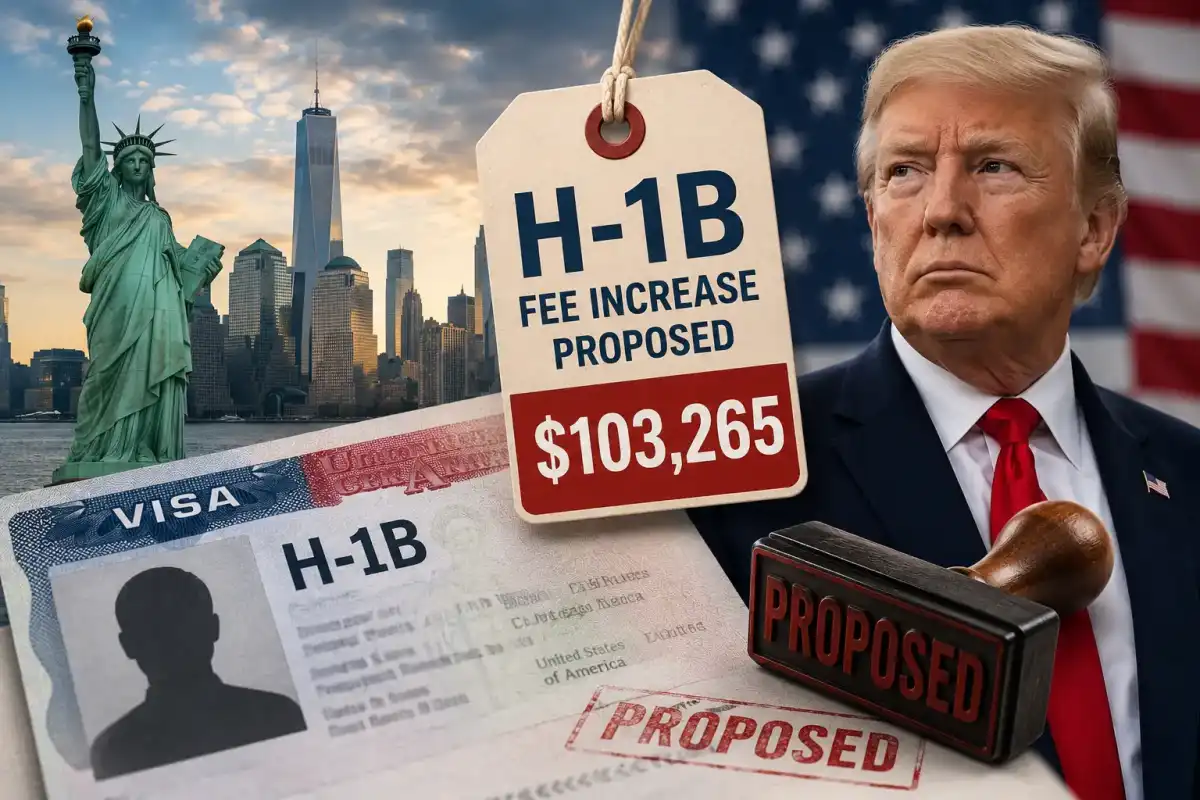
WASHINGTON: The Trump administration has proposed a new $103,265 fee for H-1B cap-subject petitions, potentially creating a six-figure cost for US employers sponsoring foreign professionals under the annual H-1B programme.
The proposal from the US Department of Homeland Security (DHS) would apply to all H-1B petitions subject to the annual numerical cap, including cases eligible for the 20,000 advanced-degree exemption for graduates with qualifying US master’s degrees or higher.
Importantly, the proposed fee would apply based on whether the petition is cap-subject, rather than simply whether the worker is physically outside or inside the United States. This means an eligible F-1 student already in the US seeking to move from OPT to H-1B through the cap could also be covered if the rule is finalized.

$103,265 Would Be an Additional Fee
The proposed $103,265 charge would not replace the existing H-1B filing fees. Instead, DHS proposes to impose it in addition to other applicable H-1B fees and payments.
DHS estimates that approximately 85,000 cap-subject petitions are covered each year — 65,000 under the regular H-1B cap and 20,000 under the US advanced-degree exemption.
The agency calculated the proposed amount by estimating approximately $8.78 billion in annual immigration-system costs and dividing that amount by the estimated 85,000 cap-subject petitions. The resulting figure was approximately $103,265 per petition.
US Master’s Graduates Are Included
One of the most significant aspects of the proposal is that the fee would also apply to petitions filed under the advanced-degree exemption.
Under the current H-1B system, up to 20,000 additional H-1B visas are available for beneficiaries who hold a qualifying master’s degree or higher from a US institution of higher education.
That means an international student who completes a master’s degree in the United States, works under F-1 Optional Practical Training (OPT) and is subsequently selected in the H-1B cap process could face the same proposed $103,265 employer-side fee when the H-1B petition is filed.
Even Applicants Already in the US Could Be Affected
The proposed rule represents a significant change from the Trump administration’s earlier $100,000 H-1B payment requirement introduced in 2025.
The earlier policy primarily targeted H-1B workers seeking entry to the United States from abroad. The new proposed rule is framed around cap-subject petitions and would therefore cover qualifying petitions even when the beneficiary is already in the United States.
This could particularly affect international students transitioning from F-1 status and OPT to H-1B status.
Who Would Not Pay the Proposed $103,265 Fee?
The proposal is not a $103,265 charge on every H-1B petition.
The fee would specifically target cap-subject H-1B petitions. DHS’s proposal excludes cap-exempt petitions and petitions involving beneficiaries who have already been counted against the H-1B cap.
As a result, the proposed fee would generally not apply to:
- H-1B extensions for workers already counted against the cap.
- Amendments to existing H-1B status.
- Transfers or changes of employer involving workers who have already been counted against the H-1B cap.
- Cap-exempt H-1B petitions, including qualifying cases involving universities, certain affiliated nonprofit organisations and qualifying research institutions.
The key distinction is whether the petition is subject to the annual H-1B cap, rather than whether the applicant is inside or outside the United States.
Proposed Fee Is Not Being Collected Yet
Despite the size of the proposed charge, employers and H-1B applicants do not currently owe $103,265 under this new proposal.
DHS has issued the measure as a Notice of Proposed Rulemaking. The proposal is scheduled for publication in the Federal Register and will be subject to a 30-day public comment period.
DHS must review the public comments and issue a final rule before the new fee can take effect. The final rule could also be changed, delayed, or challenged in court.
Important: The $103,265 amount is currently a proposed fee, not a fee that every new H-1B applicant must pay today.
Trump Administration Had Earlier Imposed $100,000 H-1B Payment
The new proposal follows the administration’s earlier attempt to impose a $100,000 payment requirement on certain new H-1B workers.
President Donald Trump introduced that requirement through a September 2025 presidential proclamation. The White House said the measure was intended to discourage employers from using the H-1B programme to replace US workers and to encourage hiring of highly skilled foreign professionals.
However, in June 2026, US District Judge Leo Sorokin ruled that the $100,000 policy was unlawful, finding that the administration had imposed what amounted to a tax without sufficient congressional authorization. The administration appealed the decision.
The new $103,265 proposal takes a different legal route. Instead of relying on the presidential proclamation’s entry restrictions, DHS is proposing the charge through formal federal rulemaking and citing its statutory authority to establish immigration-related fees.
Why Is DHS Seeking the Money?
DHS says the proposed fee would serve as a dedicated revenue mechanism to help recover the federal government’s costs of administering the US legal immigration system.
The proposal would direct money toward several federal agencies involved in immigration-related activities, including US Citizenship and Immigration Services, the Department of Labor, the Department of Justice’s immigration courts, Immigration and Customs Enforcement, the Department of State and Customs and Border Protection.
DHS estimates the proposal could generate roughly $8.8 billion annually if the full annual allocation of approximately 85,000 cap-subject petitions is reached.
Major Impact on Indian Students and IT Professionals
The proposal is particularly significant for Indian nationals because Indians make up the largest share of H-1B beneficiaries.
USCIS data cited in recent reports shows that Indian-born beneficiaries accounted for about 71% of H-1B petitions approved in fiscal year 2024.
The potential impact could be especially large for Indian students pursuing master’s degrees in the United States. Many international students use the F-1 visa, followed by OPT and, in eligible cases, STEM OPT, before seeking H-1B sponsorship.
If the proposed rule is finalized, an employer sponsoring an eligible student through the H-1B cap would have to consider the additional six-figure cost when deciding whether to hire and sponsor the worker.
Employers Could Face a Major Hiring Decision
The proposed fee would be paid by the employer or H-1B petitioner, rather than simply being a new visa fee charged directly to the worker.
For companies that regularly hire international graduates, the proposed charge could significantly change the economics of H-1B sponsorship. Employers could face a choice between absorbing the additional cost, reducing sponsorship, or seeking other ways to fill positions.
Technology companies, financial institutions, healthcare organisations and other employers that rely on highly skilled foreign professionals are therefore likely to closely monitor the rulemaking process.
Could the $103,265 Fee Face Another Court Challenge?
Legal challenges are likely to be closely watched because the proposal comes shortly after a federal judge struck down the earlier $100,000 H-1B payment requirement.
The administration argues that the new proposal has a different legal foundation and is being introduced through the formal regulatory process. Critics are expected to question whether DHS has authority to use H-1B fees to fund costs extending beyond the direct processing of H-1B petitions.
The proposed rule will therefore have to clear both the regulatory process and potentially another round of legal challenges before employers know whether the six-figure charge will become permanent.
What Happens Next?
- Federal Register publication: The proposed rule is scheduled for formal publication.
- Public comments: The public will have 30 days to submit comments.
- DHS review: The department will consider comments and determine whether changes are required.
- Final rule: DHS would need to publish a final regulation before the proposed fee could take effect.
- Potential litigation: The rule could face legal challenges after finalisation.
What H-1B Applicants Should Know Right Now
For current H-1B workers, the proposal does not mean they suddenly owe $103,265. Existing H-1B holders, extensions and many employer-transfer cases involving workers already counted against the cap are outside the proposed cap-subject fee.
For international students and other candidates entering the H-1B lottery, however, the proposal could have a much larger impact if it becomes final.
The most important point is that $103,265 is currently a proposed additional fee for cap-subject H-1B petitions. It is not yet a final fee and is not currently payable simply because someone is applying for or holding an H-1B visa.
If finalized, the proposal would represent one of the largest increases in the cost of sponsoring a new H-1B worker in the history of the programme, with US employers potentially paying more than $100,000 on top of existing immigration fees.