Hyderabad: At Telangana Tribune, we actively encourage young writers and student voices to share their perspectives on important issues shaping our society. As part of this initiative, we are publishing a thoughtful article by Tayaba Fathima, a first-year student at St. Mary’s Centenary Degree College, Hyderabad.
Through this piece, she presents a balanced and critical view of urbanization in India, highlighting both its opportunities and the challenges it brings.
Urbanization in India: Progress at What Cost?
India’s cities are rising—but so are the questions they leave behind. The steady march of urbanization, often celebrated as a marker of development and progress, demands a closer and more critical examination: who truly benefits from this transformation, and at what cost?

Urbanization, defined as the movement of people from rural to urban areas, has accelerated rapidly in India over the past few decades. Driven by the promise of employment opportunities, better education, and improved living standards, cities have become magnets for millions. Today, over one-third of India’s population resides in urban areas—a number that continues to grow, reshaping the country’s economic and social landscape.
There is little doubt that urbanization has contributed significantly to economic growth. It has strengthened the industrial and service sectors, improved infrastructure, and attracted domestic as well as global investment. Cities like Hyderabad and Mumbai stand as examples of this transformation, emerging as major hubs for technology, finance, and innovation. For many, urban life represents opportunity, aspiration, and upward mobility.
However, this growth story is incomplete without recognizing its uneven consequences. The expansion of cities has often come at the cost of agricultural land, with farms being replaced by real estate, industries, and highways. For farmers, this shift is not just economic—it is deeply impactful on livelihoods, leading to displacement, uncertainty, and financial stress. Issues like water scarcity, rising input costs, and declining agricultural returns have further intensified these challenges.
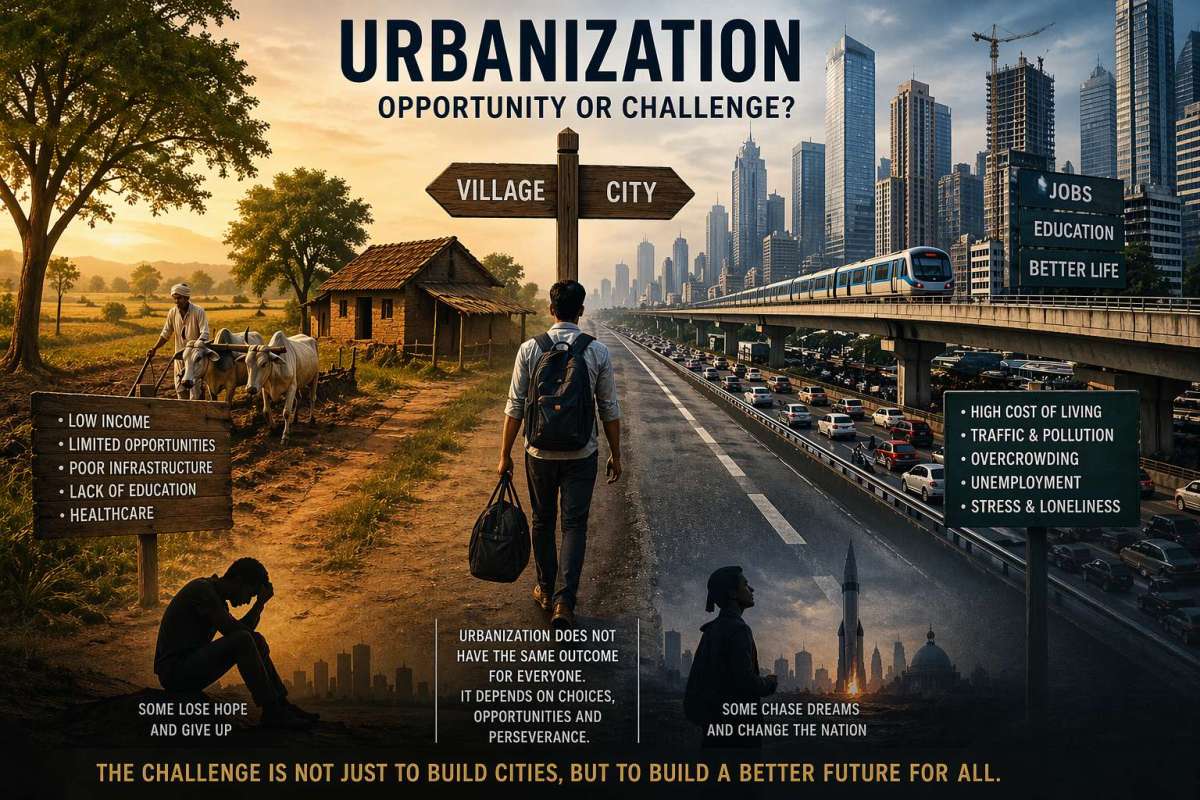
The reasons behind rural-to-urban migration highlight deeper structural gaps. In many villages, limited job opportunities, low incomes, and lack of access to quality education and healthcare leave people with little choice but to move. Cities, on the other hand, offer better infrastructure, connectivity, and exposure. Yet, the transition is rarely easy. Migrants often face high living costs, informal jobs, and lack of social security, making survival in urban areas difficult.
The effects of rapid and unplanned urbanization are becoming increasingly visible. Problems such as overcrowding, pollution, traffic congestion, and growth of informal settlements point to serious gaps in urban planning. At the same time, natural resources like water and energy are under growing pressure, raising concerns about the sustainability of urban growth.
On a human level, urbanization produces contrasting outcomes. While some individuals are able to take advantage of opportunities and succeed, others struggle and remain on the margins. The journey from rural aspiration to urban stability is not guaranteed. In contrast, inspiring figures like Dr. A. P. J. Abdul Kalam show what is possible when determination meets opportunity. Rising from humble beginnings, he went on to become a renowned scientist and the President of India. However, such success stories remain exceptions rather than the norm.
To address these challenges, several government initiatives have been introduced. Programs like the Smart Cities Mission and AMRUT (Atal Mission for Rejuvenation and Urban Transformation) aim to promote planned and sustainable urban development. However, their success depends on effective implementation and inclusivity, ensuring that the benefits of growth reach all sections of society.
At the same time, strengthening rural India remains equally important. Investments in agriculture, rural industries, education, and healthcare are necessary to reduce distress-driven migration. A balanced approach that bridges the rural-urban divide is essential for long-term development.
Urbanization, therefore, is neither entirely good nor entirely bad. It reflects the choices we make about development, equity, and sustainability. The real challenge lies in shaping it in a way that is inclusive, balanced, and sustainable.
A nation’s progress cannot be measured only by the growth of its cities, but by how well it supports its people across both urban and rural landscapes.