
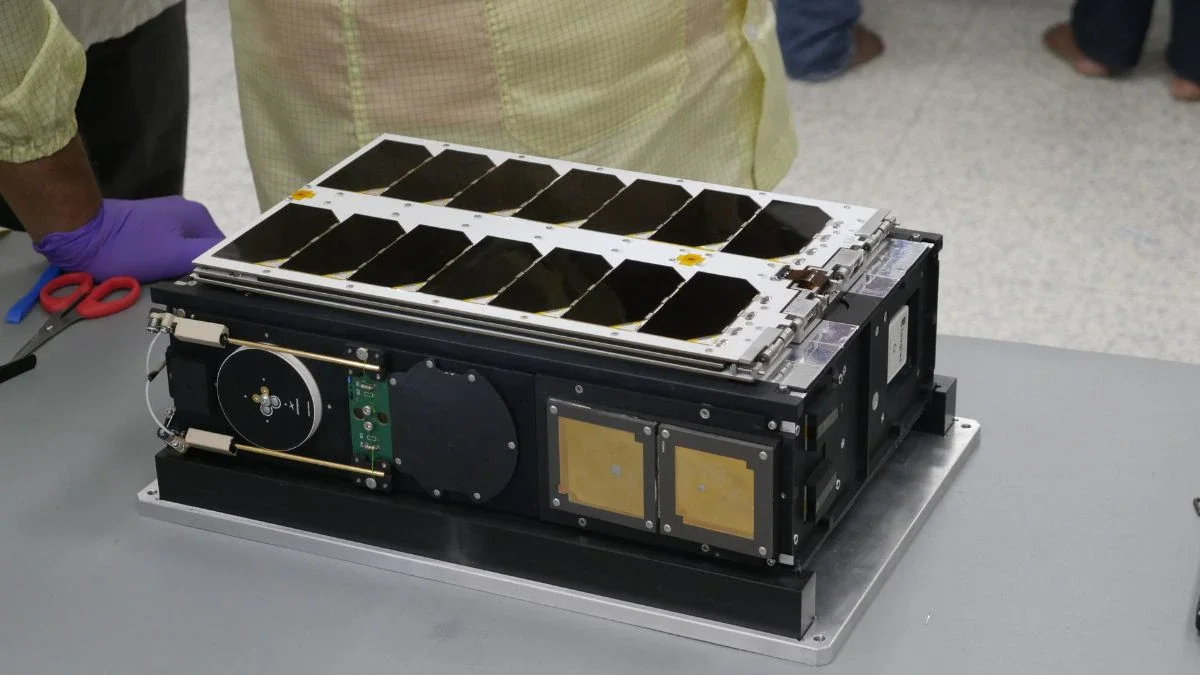
Two Hyderabad-based startups are preparing to launch what they call the world’s first rentable satellite laboratory into space. The MOI-1 satellite, weighing just 14 kilograms, will be carried aboard the Indian Space Research Organisation’s PSLV-C62 mission scheduled for January 12. The satellite can be rented for approximately $2 per minute, roughly Rs 180, offering researchers and companies access to space technology without the need to own expensive hardware.
TakeMe2Space and Eon Space Labs, the two companies behind this initiative, have developed a system that allows users to upload their own artificial intelligence code to the satellite while it orbits 500 kilometres above Earth. Founder Ronak Samantray explained that the space sector has traditionally been restricted to well-funded organizations due to massive costs. The new model enables millions of researchers and small companies to run their own code in orbit without investing crores in satellite ownership.
The satellite features an onboard GPU (Graphics Processing Unit) that processes data in space rather than sending raw images back to Earth. This approach addresses a critical inefficiency in traditional satellite operations, where over 40 per cent of captured images are obscured by clouds. By identifying and filtering out cloud-covered images in orbit, the system reduces data costs by eight times. Users receive processed information and coordinates instead of gigabytes of unusable imagery.
At the heart of MOI-1 sits the MIRA space telescope, developed by Eon Space Labs as India’s first monolithic space telescope. Co-founder Sanjay Kumar revealed that the entire optical system is carved from a single block of fused silica glass using ultra-precision grinding and polishing. Weighing just 502 grams, it is claimed to be the world’s lightest high-resolution telescope of its kind. The monolithic design eliminates mechanical complexity and prevents optical misalignment during the violent vibrations of rocket launches.
The entire mission was developed for Rs 2.5 crore, a fraction of what comparable space missions typically cost. The team achieved this by using off-the-shelf military-grade components, similar to those in high-end drones, protected by a proprietary radiation-shielding coating. This material science innovation allows commercial-grade chips to survive cosmic radiation without requiring expensive space-hardened hardware, reducing mission costs by an estimated 70 per cent.
The PSLV-C62 mission will be dominated by the Defence Research and Development Organisation’s Anvesha satellite, but the small MOI-1 co-passenger represents a significant shift in how space resources can be accessed. The satellite operates on a pay-as-you-go model, similar to how internet cafes in the 1990s democratized access to computing technology. Researchers can rent processing power for specific tasks rather than investing in entire satellite systems.
Samantray outlined plans to expand the concept into a 6-kilowatt orbital power grid by 2027. The vision involves a constellation of six satellites creating a shared processing pool in space, functioning like cloud computing services such as Amazon Web Services but in orbit. Satellites would be able to share resources like power and processing capabilities, with smaller satellites able to offload heavy data processing tasks to this orbital infrastructure.
The initiative aims to transform India into a computing backbone for the global space industry. Kumar stated that the goal was to create an indigenous system that is both rugged and precise, capable of surviving the stresses of spaceflight while maintaining optical accuracy. The team’s approach demonstrates that terrestrial technology can be adapted for space applications through innovative material science, creating opportunities for startups to enter orbit without massive capital investment.


