Hyderabad: The Telangana Government has introduced major reforms to its Transferable Development Rights (TDR) policy through G.O. Ms. No. 95 (March 2026), bringing significant relief to developers while aiming to improve urban planning efficiency. The updated rules redefine high-rise norms, introduce slab-based TDR loading, and offer flexibility in payments.
Major Highlights of the New TDR Policy
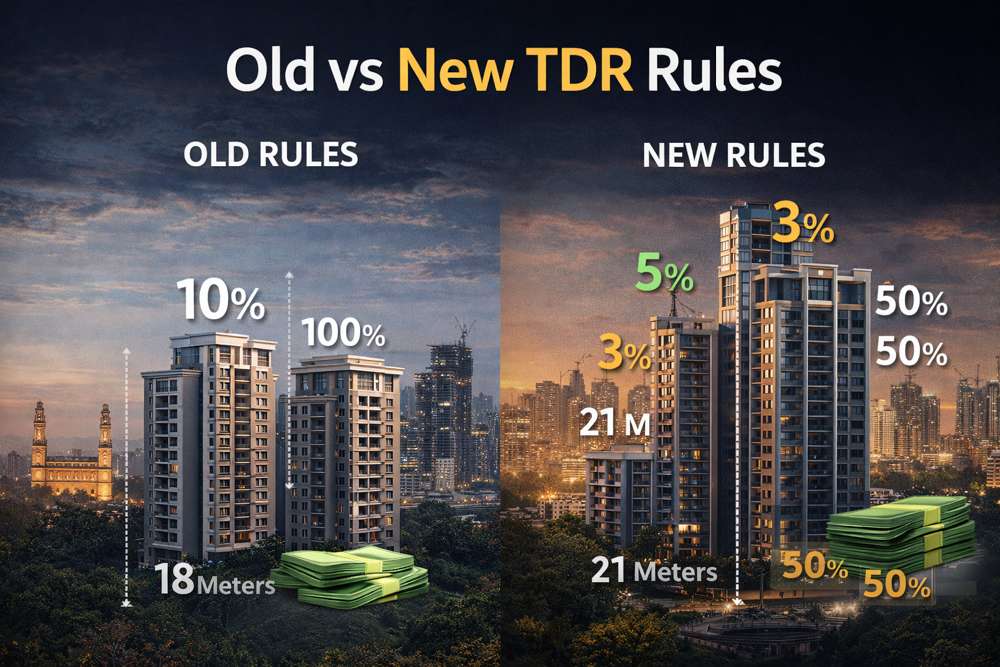
One of the most notable changes is the redefinition of high-rise buildings. A structure is now classified as a high-rise only if it exceeds 21 meters, compared to the earlier threshold of 18 meters.
The government has also replaced the earlier flat TDR requirement with a slab-based mandatory TDR system, making it more practical and aligned with real-world project scales.

Mandatory TDR Loading (New System)
- 11 to 20 Floors: 3% of built-up area above the 10th floor must use TDR
- 21 Floors and Above: 5% of built-up area above the 20th floor must use TDR
- Mid-size plots (750–2000 sq.m): Buildings between 18m–21m height must use TDR for approval
Additionally, developers now benefit from payment flexibility, where only 50% of TDR is required upfront, and the remaining 50% can be submitted before obtaining the Occupancy Certificate (OC).
Old vs New TDR Rules – Detailed Comparison
| Feature | Old Rule (Pre-March 2026) | New Rule (G.O. 95) | Advantage |
|---|---|---|---|
| High-Rise Threshold | 18 Meters | 21 Meters | Fewer approvals (NOCs); faster execution |
| TDR Submission | 100% Upfront | 50% at approval, 50% before OC | Improves cash flow for developers |
| TDR Loading (11–20 Floors) | Flat 10% requirement | 3% above 10th floor | Lower cost for mid-range projects |
| TDR Loading (21+ Floors) | Flat 10% requirement | 5% above 20th floor | More balanced and scalable policy |
| Mid-Size Plot Rules | No clear TDR linkage | TDR mandatory for 18m–21m buildings | Structured development control |
| Additional Floors | Not clearly linked to road width | Up to 5 additional floors via TDR | Higher ROI for large plots |
| Setback Relaxation | Rigid plot-based rules | Up to 10% relaxation via TDR | Better land utilization |
Impact on Real Estate Sector
The revised TDR policy is expected to significantly benefit the real estate and construction sector in Telangana. By reducing upfront costs and simplifying regulations, the government aims to encourage faster project execution and increased investments.
Industry experts believe the new framework will particularly boost mid-size and high-rise residential projects, while also improving the feasibility of large-scale developments in urban areas like Hyderabad.
With these changes, Telangana is moving towards a more developer-friendly and growth-oriented urban policy, balancing infrastructure expansion with economic viability.