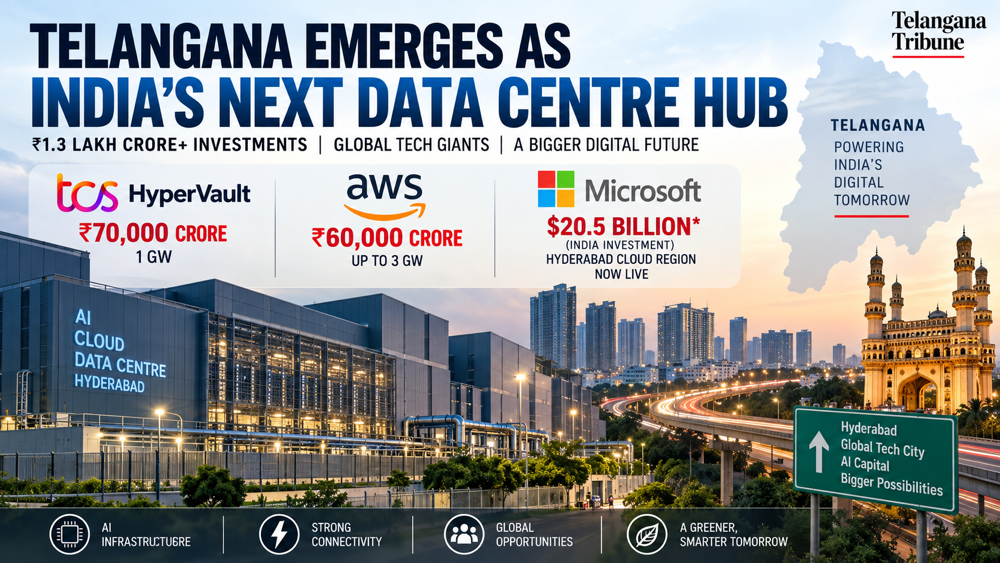
HYDERABAD: Telangana is rapidly turning into one of India’s biggest battlegrounds for the next generation of digital infrastructure.
For years, Hyderabad’s technology story was largely defined by software companies, IT parks and global capability centres. That story is now expanding dramatically. The next wave is being built around something far less visible but potentially just as important: massive data centres capable of powering cloud computing, artificial intelligence and high-density GPU workloads.
The latest announcement by TCS subsidiary HyperVault has pushed Telangana’s ambitions into an entirely new league. The company and its partners plan to invest up to ₹70,000 crore to develop an AI data centre campus in Hyderabad with capacity of up to 1 gigawatt.
The project, planned on 264 acres, is expected to become one of the largest and most advanced AI infrastructure campuses in India when fully developed.
TCS HyperVault Brings a ₹70,000 Crore AI Bet to Hyderabad
The HyperVault project is particularly significant because it is not being designed as a conventional data centre.
The proposed campus will target frontier AI companies, hyperscalers and high-density computing workloads. That means infrastructure capable of supporting the enormous computing requirements of artificial intelligence training, inference and advanced GPU-based applications.
The campus is expected to be developed in phases based on customer demand and technology requirements. TCS has also said the infrastructure will incorporate high-density and liquid-cooled computing systems, while the broader project will follow green energy and water-neutral design principles.
At full scale, the ₹70,000 crore investment would represent one of the largest private-sector commitments ever made to AI infrastructure in Telangana.
AWS Is Already Building Its Next Major Hyderabad Expansion
HyperVault is not arriving in an empty market.
Amazon Web Services has already committed approximately ₹60,000 crore towards expanding data centre infrastructure in Telangana over the coming years.
AWS broke ground for a major hyperscale data centre development at Bharat Future City in July 2026. The company has been allotted land for projects in Bharat Future City as well as Chandanvelly, adding another major layer to Telangana’s growing cloud infrastructure footprint.
Amazon has described Hyderabad as an increasingly important part of its cloud strategy in India, particularly as demand grows for cloud services and artificial intelligence infrastructure.
The scale of the AWS commitment matters because hyperscale cloud infrastructure tends to attract an entire supporting ecosystem around it — including networking companies, electrical equipment suppliers, cooling specialists, construction firms, security providers and skilled technical workers.
Microsoft’s Hyderabad Cloud Region Is Now Live
Microsoft has also strengthened Hyderabad’s position in India’s cloud economy.
In August 2026, Microsoft announced the general availability of its India South Central cloud region in Hyderabad, expanding its hyperscale cloud presence in the country.
The new region allows eligible Microsoft Cloud services and workloads to be operated from Hyderabad, providing enterprises with another option for locally hosted cloud infrastructure.
However, one distinction is important when comparing investment figures. The widely reported $20.5 billion figure relates to Microsoft’s broader investment and expansion in India and should not be treated as a Telangana-only data centre investment.
Telangana’s Data Centre Pipeline Is Growing Beyond the Big Three
The story is also bigger than TCS, AWS and Microsoft.
Telangana has been actively positioning itself as an AI and data centre destination, with the state government pursuing additional projects and dedicated infrastructure clusters.
In January 2026, the Telangana government announced an agreement with the UPC–Volt joint venture for a proposed 100 MW AI data centre at Bharat Future City, involving an investment of around ₹5,000 crore over five years.
The project is also expected to include dedicated renewable energy infrastructure to support its power requirements.
The government has additionally been exploring the development of a dedicated Data Centre City, reflecting a strategy that goes beyond attracting individual facilities and instead focuses on building entire infrastructure clusters designed for hyperscale and AI workloads.
Why Hyderabad Is Becoming Attractive to Data Centre Companies
Hyderabad has several advantages that are becoming increasingly important in the global race for AI infrastructure.
- Large technology talent pool: Hyderabad already has one of India’s strongest IT and engineering ecosystems.
- Established global technology presence: Major cloud companies, software firms and global capability centres already operate in the city.
- Strong fibre connectivity: Large data centres require multiple high-capacity and resilient network connections.
- Government support: Telangana has actively promoted the sector through policy support and infrastructure planning.
- Growing AI ecosystem: The state is increasingly positioning Hyderabad as a destination for AI computing, research and enterprise technology.
Telangana was also among the early Indian states to introduce a dedicated policy framework for data centres, recognising the industry’s unique requirements for uninterrupted electricity, high-speed connectivity and large-scale cooling infrastructure.
The Real Challenge: Can Telangana Support Gigawatt-Scale Computing?
The investment announcements are enormous. But so are the infrastructure requirements.
A 1-gigawatt-scale AI data centre campus is not simply another commercial real estate project. It represents a massive demand for electricity, cooling systems, substations, transmission infrastructure and backup capacity.
This is where Telangana’s data centre ambitions will face their biggest test.
As more hyperscale facilities are announced, the state will need to ensure that its power infrastructure can expand at the same speed as private investment. Dedicated high-voltage substations, redundant electricity supply and renewable energy capacity will become increasingly important.
Water is another major consideration. Modern data centres can require significant cooling infrastructure, particularly facilities built for high-density AI computing. Telangana’s strategy is therefore increasingly focused on efficient cooling, recycling, treated water and renewable energy.
The challenge for policymakers will be ensuring that Hyderabad becomes a global computing hub without placing unsustainable pressure on the city’s electricity and water systems.
Data Centres Could Create a New Industrial Ecosystem
Unlike a traditional IT office, a hyperscale data centre creates demand across a much wider infrastructure supply chain.
Large facilities require:
- Power transmission and electrical equipment
- Transformers and substations
- Cooling and liquid-cooling systems
- Backup power infrastructure
- Networking and fibre connectivity
- Specialised construction and engineering services
- Security and facility management
- Hardware maintenance and technical operations
That means the long-term economic impact could extend well beyond the companies operating the servers.
The construction phase of these projects can generate significant employment and supplier activity, while the larger opportunity lies in building a local ecosystem around AI infrastructure, cloud engineering, power systems and advanced computing.
From Cyberabad to an AI Infrastructure Hub?
Hyderabad has already gone through several technology transformations.
It became a major destination for software services. Then came the expansion of global technology companies and massive IT campuses. More recently, Hyderabad emerged as one of India’s fastest-growing centres for Global Capability Centres.
The next phase could be very different.
Instead of only housing the people who write software, Telangana is now trying to build the physical infrastructure that powers the software and AI systems of the future.
The combination of TCS HyperVault’s proposed ₹70,000 crore AI campus, AWS’s ₹60,000 crore Telangana data centre commitment, Microsoft’s operational Hyderabad cloud region and additional AI infrastructure projects suggests that this transition is already underway.
The Numbers Are Big — But Execution Will Matter More
Investment announcements alone do not make a global technology hub.
The real test will be execution.
Can Telangana deliver enough reliable power? Can renewable energy capacity grow alongside AI computing? Can cooling and water systems remain sustainable? Can fibre and network infrastructure keep pace with hyperscale demand?
Those questions will determine whether Hyderabad simply attracts a series of large data centre projects or develops into one of Asia’s most important AI computing and cloud infrastructure hubs.
For now, the direction is becoming increasingly clear.
Telangana’s technology story is no longer just about offices filled with software engineers.
Increasingly, it is about the enormous infrastructure being built outside those offices — the power, processors, networks and data centres that could define the next era of India’s AI economy.