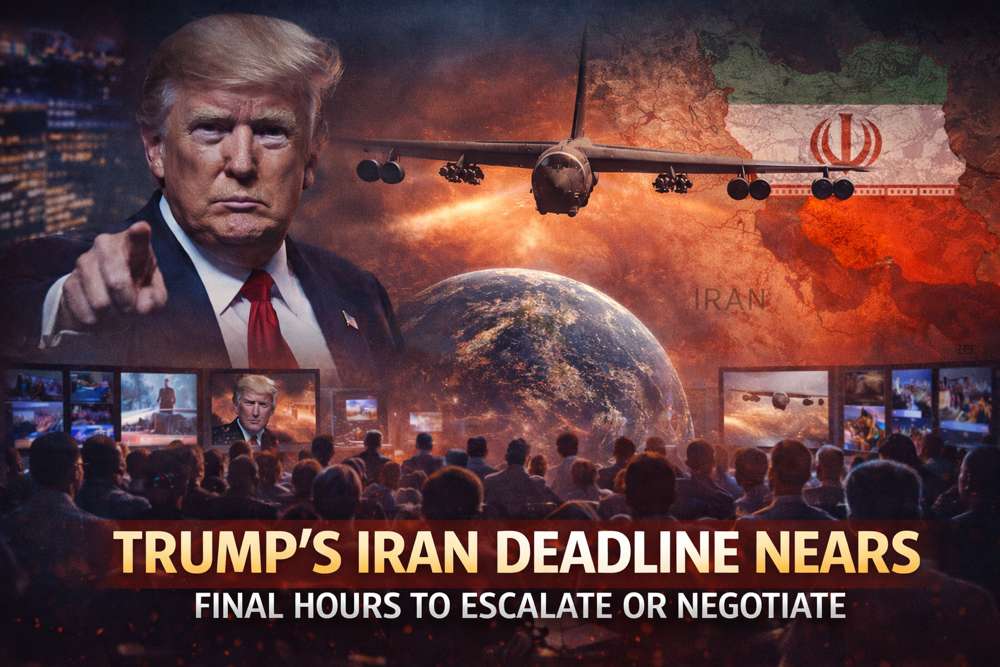
April 8, 2026: With less than two hours remaining before former US President Donald Trump’s 8 PM ET deadline, global attention is fixed on whether Iran will reopen the strategically crucial Strait of Hormuz or face a fresh wave of large-scale US military strikes.
The situation remains highly fluid, with no official breakthrough announced so far. However, back-channel diplomacy led by Pakistan continues at an intense pace, offering a narrow window to avoid escalation.
Diplomatic Push for Delay
Sources indicate that Pakistan has urged a two-week extension to allow negotiations to progress. The request is currently under consideration in Washington, with officials describing ongoing discussions as “serious and active.”
There are signs that the United States is weighing its options, with past instances showing that deadlines have been extended under similar pressure. This makes a short delay or temporary pause one of the most likely immediate outcomes.
Iran’s Position Remains Firm
Iran has so far refused to comply with demands for an immediate reopening of the strait, instead pushing for a broader, long-term agreement. Its proposal includes a permanent end to hostilities, lifting of sanctions, and guarantees against future attacks.
Officials in Tehran have dismissed US rhetoric, indicating that any compliance would require significant concessions rather than short-term arrangements.
Military Build-Up Signals Readiness
On the military front, the United States has already positioned assets for possible action. B-52 strategic bombers have reportedly been deployed and are within operational range, signaling preparedness for rapid escalation if talks fail.
Planned targets are believed to include critical infrastructure such as power plants, bridges, and military facilities, which could significantly disrupt Iran’s internal systems.
Possible Scenarios in the Next Few Hours
Based on current developments, four key outcomes are being closely watched:
- Short delay or extension: Most likely scenario if diplomatic talks show progress.
- Full compliance by Iran: Immediate reopening of the strait, avoiding strikes.
- No agreement: Large-scale US airstrikes begin shortly after the deadline.
- Interim deal: Partial reopening with continued negotiations.
Global Impact and Market Tension
The uncertainty has already begun affecting global oil markets and shipping routes, as the Strait of Hormuz remains a critical chokepoint for energy supplies. Any disruption or escalation could have immediate economic consequences worldwide.
No Nuclear Threat, But High Stakes
Officials have clarified that the current conflict involves conventional military operations only, with no indication of nuclear weapons being used. However, analysts warn that prolonged escalation could further destabilize the region.
Final Hours Critical
As the deadline approaches, the situation remains on a knife-edge. Diplomatic channels are still active, but time is rapidly running out.
The next few hours could determine whether the conflict escalates into a major confrontation or pauses for negotiation. Governments, markets, and observers worldwide are closely watching developments as the clock moves toward a decisive moment.