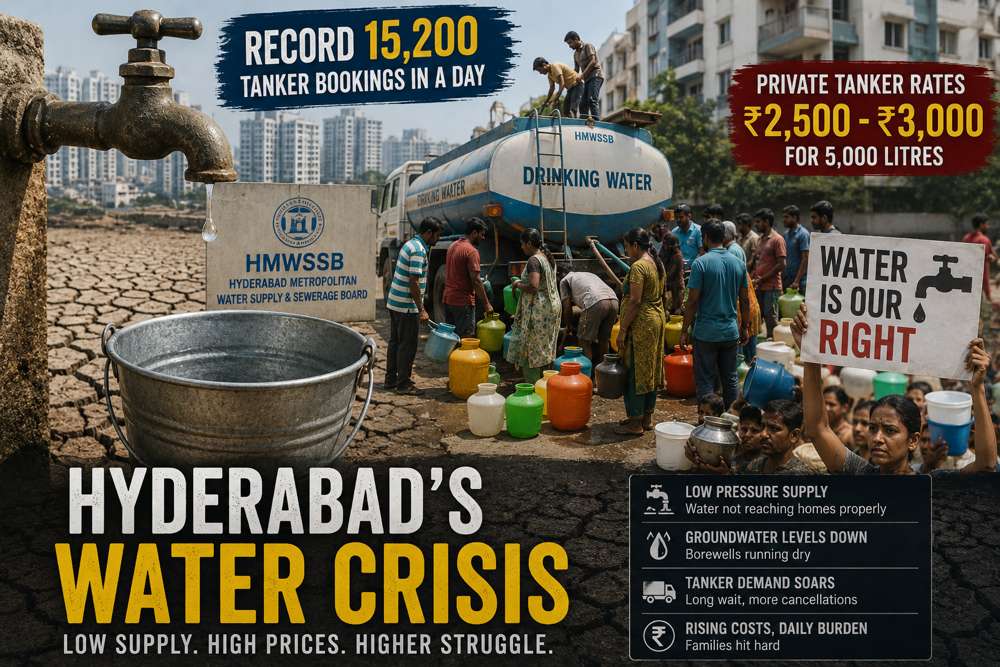
Hyderabad: Hyderabad is witnessing one of its most severe summer water crises in recent years, with record-breaking tanker demand, falling groundwater levels, low-pressure municipal supply, and soaring private tanker prices causing widespread hardship across the city.
The situation has become particularly challenging in rapidly growing residential corridors across western, north-western, and peripheral Hyderabad, where thousands of households are increasingly dependent on water tankers for their daily water needs.
Record 15,200 Tanker Bookings in a Single Day
The scale of the crisis became evident after the Hyderabad Metropolitan Water Supply and Sewerage Board (HMWSSB) recorded an all-time high of approximately 15,200 tanker bookings in a single day. The figure is believed to be the highest ever recorded by the utility and reflects the growing dependence on tanker supply across the city.
Officials have reportedly deployed hundreds of tankers daily to meet the unprecedented demand, but many consumers continue to report delays, shortages, and difficulties in securing timely deliveries.
Residents Complain of Low-Pressure Water Supply
Residents across several localities have complained that municipal water is being supplied at extremely low pressure, making it difficult to fill overhead tanks, especially in apartment complexes and multi-storey buildings.
Many resident welfare associations say they are receiving insufficient quantities despite scheduled supply timings and are increasingly dependent on tanker water to maintain daily operations.
Private Tanker Rates Surge to ₹3,000
The growing shortage has also triggered a sharp rise in private tanker charges. Residents in several parts of Hyderabad report that private operators are charging between ₹2,500 and ₹3,000 for a 5,000-litre tanker, depending on location and availability.
Apartment communities that previously relied on one or two tankers per week are now booking multiple tankers every day, significantly increasing monthly maintenance and water expenses.
Complaints Over Cancelled Tanker Bookings
Several consumers have also raised concerns regarding tanker booking cancellations. Residents claim that some bookings are being marked as cancelled with remarks stating that the “customer denied delivery” despite customers waiting at the location.
Consumers have urged HMWSSB to improve monitoring of tanker operations and introduce greater transparency in the booking and delivery process.
Groundwater Levels Continue to Decline
Experts attribute much of the current crisis to declining groundwater reserves across Hyderabad’s rapidly urbanising regions. Several borewells that previously supplied apartments and gated communities have either dried up completely or witnessed significant reductions in yield.
The problem is particularly visible in newly developed residential corridors beyond the Outer Ring Road, where dependence on groundwater remains high.
Demand Rising Faster Than Supply
Urban planners point out that Hyderabad’s population, housing stock, and commercial development have expanded rapidly over the past decade. However, water demand has increased at a pace that continues to put pressure on existing infrastructure.
The expansion of HMWSSB service areas into newly urbanised regions has further increased the burden on the city’s water supply network, especially during peak summer months.
Citizens Seek Long-Term Solutions
Resident welfare associations and civic groups are calling for long-term measures to address Hyderabad’s recurring summer water challenges. Key demands include:
- Faster completion of Godavari water augmentation projects
- Protection and revival of lakes and water bodies
- Groundwater recharge initiatives
- Mandatory rainwater harvesting enforcement
- Better regulation of private tanker operations
- Improved water infrastructure in newly developed areas
- Transparent tanker booking and delivery systems
With summer conditions continuing and groundwater reserves under pressure, thousands of Hyderabad residents remain dependent on tankers for their daily water needs. Citizens say immediate interventions and long-term planning are essential to prevent the crisis from worsening in the coming years.