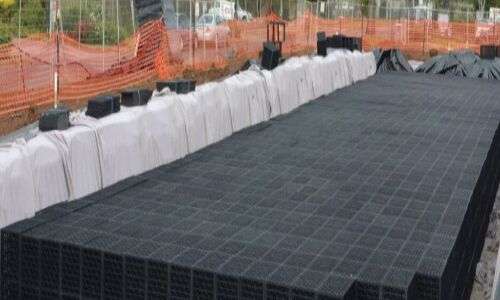
Heavy rainfall often leads to severe flooding on roads due to the accumulation of water. To address this issue, a promising solution is the implementation of modular rainwater harvesting. Urban areas can experience urban flooding when the natural drainage systems become overwhelmed by rainfall, causing excessive water runoff on roads and other surfaces. This not only disrupts transportation but also poses risks to property and public safety.
The modular rainwater harvesting system is designed to tackle stormwater issues at their source. By placing modular units along roadsides, park peripheries, and under metro bridges, this system captures rainwater efficiently during heavy downpours. The captured stormwater undergoes a natural filtration process with sand and geotextile filtration, removing pollutants and contaminants to produce high-quality stormwater. This approach can be used in road sidewalks, park peripheries, road dividers, and trenches under metro bridges, making it an effective solution for combating stormwater logging and promoting sustainable urban development.
Kalpana Ramesh, Founder of Rain Water Project, explains that modular rainwater harvesting pits have an advantage over traditional pits located on rooftops or green spaces. They require minimal maintenance and can serve effectively for 20 to 25 years. This innovative approach not only helps preserve water but also enhances groundwater resources. Deploying these modular systems, especially beneath flyovers, can transform these spaces into lush green areas, earning support and admiration from the public for their sustainable impact.

The modular setup includes a plastic filtering mechanism to prevent debris and plastic waste from contaminating the collected rainwater. The stormwater undergoes purification through sand filtration to remove impurities and sediments. This initial filtration process makes the rainwater relatively clean and suitable for non-potable uses. However, more advanced filtration and treatment processes are required for sewage water to become reusable.
By positioning the modular units in gravity-based configurations, the harvested water can flow naturally to ponds, injection bore wells, and lakes. This gravity-assisted transportation reduces the need for energy-intensive pumps, making the process more environmentally friendly and cost-effective.
Dr. M.V.S.S. Giridhar, Professor and Head of the Centre for Water Resources at Jawaharlal Nehru Technical University, Hyderabad (JNTU-H), highlights that despite government efforts to encourage rainwater harvesting practices, many residential societies and gated communities have not taken sufficient initiative in adopting these practices.