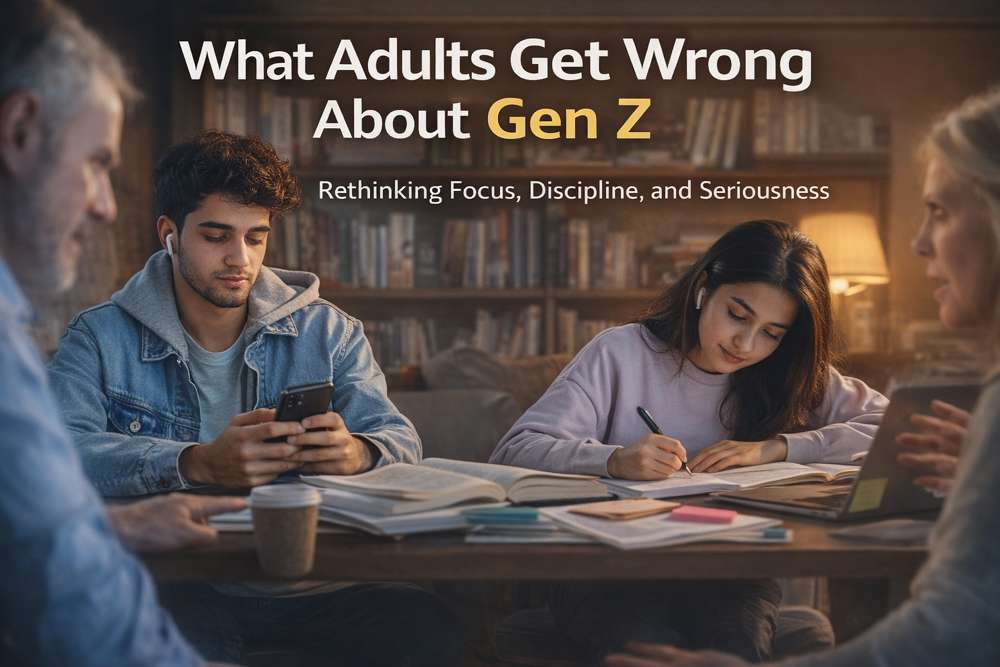
In recent years, conversations around Generation Z have become increasingly common—and increasingly judgmental. From classrooms to workplaces, young people are often described as distracted, overly dependent on screens, and lacking discipline. But are these labels accurate, or do they reflect a deeper generational disconnect? In this reflective piece, Tayaba Fathima, a student from Hyderabad studying in St. Mary’s Centenary Degree College, shares her perspective on how Gen Z is frequently misunderstood, not because of who they are, but because of how the world around them has changed.
Every generation is misunderstood before it is understood.
Adults often describe Gen Z as distracted, unserious, and addicted to screens. But what adults truly get wrong is this: they confuse a different way of thinking with a lack of discipline, and a different way of focusing with irresponsibility. Gen Z is not failing to meet old standards—they are operating in a world those standards were never designed for.
Gen Z did not grow up in a slow, stable environment. They grew up with constant notifications, academic pressure, social comparison, and career uncertainty happening simultaneously. Expecting them to learn, work, and behave exactly like previous generations is not guidance—it is misunderstanding.
Adults need to ask themselves an uncomfortable question: Is Gen Z really unfocused, or are we judging them using rules from a world that no longer exists? When traditional definitions of discipline stop working, it is easier to criticize the young than to rethink expectations.
One of my Gen Z friends is studying law. She watches Instagram reels, stays updated with trends, and follows gossip like many people her age. To an adult observer, this might look like a lack of seriousness. But her ambition tells a different story. She wants to become a successful lawyer and prove everyone who ever doubted her wrong. She does not fear failure; the thought of downfall only sharpens her concentration. For her, being digitally aware and professionally driven are not contradictions—they coexist.
At the same time, I have another Gen Z friend who presents the opposite reality. She enjoys social media and companionship but struggles with multitasking. When she tries to focus on studies, distraction takes over. This does not make her lazy or careless. It simply shows that focus is not the same for everyone, even within the same generation. Yet adults often place both individuals under one label: “Gen Z lacks focus.”
This habit of generalization is not new. In my neighborhood lives a millennial woman with one daughter. When she teaches her child, her focus becomes absolute. Household chores, meals, and even time itself fade into the background. Her concentration is deep but singular.
Nearby lives another millennial woman with six children. Despite the demands of a large family, she manages to teach her children while handling household work efficiently. Multitasking comes naturally to her. Both women belong to the same generation, yet their abilities and limits are entirely different.
These examples make one thing clear: focus, discipline, and multitasking are individual traits, not generational flaws. Every generation has people who thrive under pressure and others who function best with single-task focus.
Adults often misunderstand Gen Z not because this generation lacks seriousness, but because they refuse to accept that seriousness can look different today. Gen Z questions more, feels more, and expresses more because the world they live in demands awareness and adaptability.
In a time when rapid change defines everyday life, Tayaba’s reflections invite readers to pause and reconsider long-held assumptions. Rather than measuring Gen Z against outdated benchmarks, her words encourage a more empathetic understanding—one that recognizes individuality over labels, and evolution over comparison. As society continues to change, so too must the way generations listen to and learn from one another.
— Tayaba Fathima