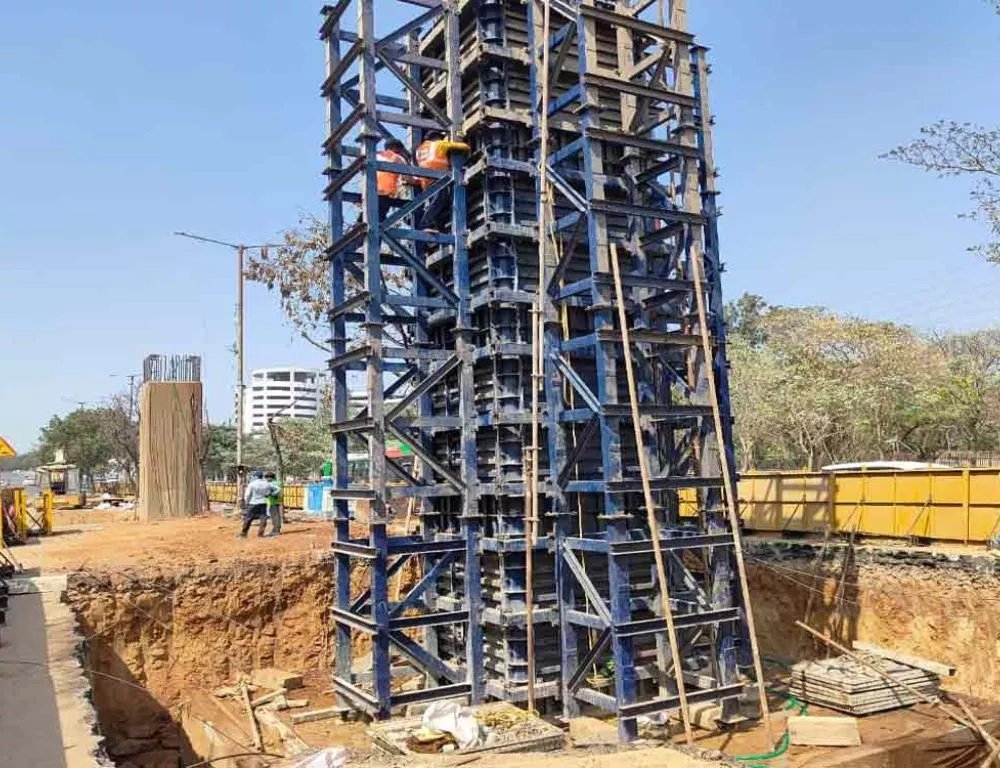
Construction work has officially commenced on the long-awaited multi-level flyover project at IIIT Junction in Hyderabad. Several pillars have already been erected in front of the Indian Institute of Information Technology (IIIT), marking visible progress on this crucial infrastructure development. The project aims to address severe traffic congestion at one of the city’s most congested intersections.
The ambitious project encompasses two flyovers and one underpass designed to streamline traffic flow across multiple directions. The first component is a 4-lane bidirectional flyover that will connect ISB (Indian School of Business) to DLF, providing seamless connectivity for vehicles traveling in both directions. This major arterial route is expected to handle a significant volume of daily traffic.

The second flyover will be a 2-lane one-way structure running from the Mumbai Highway to DLF. This dedicated pathway will facilitate smoother movement for vehicles heading towards the DLF area, reducing bottlenecks during peak hours. The one-way design is strategically planned to optimize traffic distribution across the junction.
The third critical component is a bidirectional underpass on the Mumbai Highway, connecting Indira Nagar to Hyderabad Central University (HCU). This underground passage will allow uninterrupted movement along the highway corridor, separating through traffic from local junction traffic. The underpass is expected to significantly reduce waiting times for commuters traveling along this busy stretch.
IIIT Junction has been notorious for massive traffic snarls, particularly during morning and evening rush hours. Thousands of commuters, including students, IT professionals, and residents from surrounding areas, navigate this intersection daily. The convergence of multiple major roads at this point has made it a persistent bottleneck in Hyderabad’s road network.
Once the multi-level flyover project reaches completion, traffic congestion at this junction is expected to ease considerably. The three-tier infrastructure solution will segregate traffic flows, allowing vehicles to move through the area without conflicting with cross-traffic. The project represents a significant investment in improving Hyderabad’s transportation infrastructure and reducing commute times for residents.